

- Joined
- Feb 2, 2011
- Messages
- 2,373
THE EIGHTEENTH CENTURY COLLECTION
THE AMERICAN WAR OF INDEPENDENCE
THE BATTLE OF BUNKER HILL, 17th JUNE 1775.
THE ASSAULT ON THE REDOUBT AT BREED’S HILL
Boston was the third largest town in North America, and stood on a Peninsula connected to the mainland by a neck just wide enough to cross at high tide. The harbour, large enough to be strategically significant, and central to the town’s economy, was formed by a chain of islands stretching out to sea, guarded by reefs and ledges.
North west of Boston was Charlestown, a largely rural peninsula one and a half miles long. Charlestown stood at the south east corner with three hills behind it. Bunker’s Hill, nearest the neck of the Peninsula, Breed’s Hill 200 yards above the town and Moulton’s Hill to the north east.
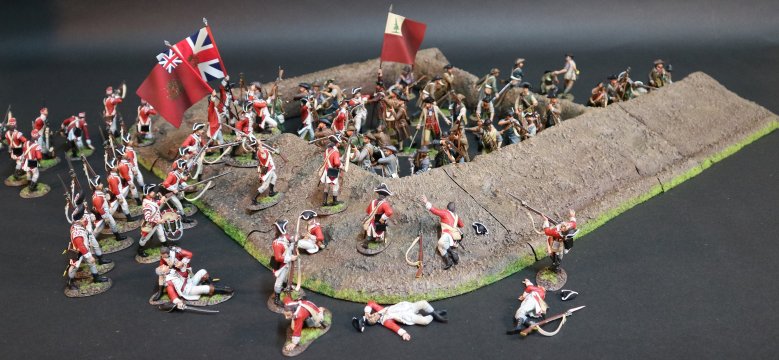
On the 16th June 1775, 3 detachments from Massachusetts regiments under the command of Colonel William Prescott and engineer Captain Richard Gridley, crossed the Charlestown neck and arrived at Bunker Hill.
Captain Richard Gridley and Prescott disagreed as to where they should locate their defense. Some work was performed on Bunker Hill, but Breed’s Hill was closer to Boston and viewed as being more defensible, and they decided to build their primary redoubt there.
Prescott and his men began digging a square fortification about 130 ft a side with ditches and earthen walls. The walls of the redoubt were about 6 feet high.
Work began at midnight, and around 4am one of the British warships spotted the earthworks on Breed’s Hill and opened fire.
The British command agreed that the works posed a significant threat, but were at this time sufficiently incomplete and isolated to offer a chance of a successful attack.
The original British plan was to bypass the redoubt to the north and capture Bunker’s Hill and the neck of the peninsula, thus isolating the redoubt on Breed’s Hill.
The Americans repulsed two British assaults, with significant British casualties. The British captured the redoubt on their third assault, after the defenders had run out of ammunition. The colonists retreated over Bunker Hill, leaving the British finally in control of the Peninsula.
The battle was a tactical victory for the British, but it proved to be a sobering experience for them; they incurred many more casualties than the Americans had sustained, including many officers. The battle had demonstrated that inexperienced militia were able to stand up to regular army troops in battle. Subsequently, the battle discouraged the British from any further frontal attacks against well defended front lines. American casualties were much fewer, although their losses included General Joseph Warren, and Major Andrew McClary, the final casualty of the battle.
BRITISH MARINES
The Marines, which only became “Royal Marines” in 1802, were the Royal Navy’s private army, administered by the Admiralty and controlled by senior naval officers. The rank and file were volunteers and wore army style uniforms and equipment. However they were trained to serve on warships and undertake amphibious operations. The 50 companies, shared between Chatham, Portsmouth and Plymouth, were not regimented, and detachments, or in some cases individual replacements were assigned on an ad hoc basis.
The first Marines sent to Boston were to form a battalion of 600 men under Major Pitcairn, but by March only 336 were present, as they soon became an object of inter service rivalry over pay, food and conditions. Although initially physically inferior to their army comrades, and short of essential equipment for service on land, incessant drilling and regular marches into the countryside soon created a fine unit.
Another group of over 700 men arrived in May, and the whole force formed two battalions, with grenadier and light companies.
The 1st and 2nd Marines were to play an important part in the assault on the southern defences of the Breed’s Hill redoubt.
MAJOR ROBERT ROSS
Major Robert Ross was born in 1740, and was commissioned on the 17th June 1756 as a Lieutenant of 86 Company in Chatham. He was to serve at the Siege of Louisbourg in 1758, and the capture of Quebec in 1759.
In 1773 was dispatched to America and appointed commander of 5 Company 1st Battalion. At the Battle of Bunker Hill Captain Ross was singled out for commendation in leading 5 Company during the assault on Breeds Hill.
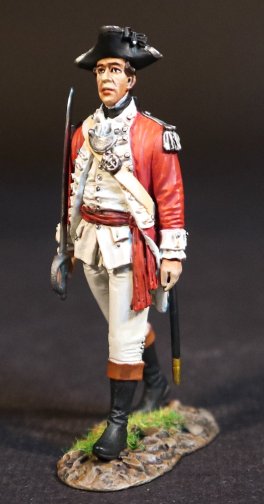
MBHL-24
THE AMERICAN WAR OF INDEPENDENCE 1775-1783,
THE BATTLE OF BUNKER HILL, JUNE 17th 1775,
THE ASSAULT ON THE REDOUBT AT BREED’S HILL,
BRITISH MARINES,
CAPTAIN ROBERT ROSS
In August 1779 he was taken prisoner by the French in the English Channel, and was later released.
After two years serving in the Mediterranean and the West Indies he was promoted to brevet major.
On the 12th October 1786 was appointed commandant of the NSW Marine Corps detachment, and later on the 24th October 1786 became Lieutenant Governor of New South Wales.
He was to return to England in 1792 where he became a recruiting officer.
His death is recorded st Brampton on the 9th June 1794.
THE AMERICAN WAR OF INDEPENDENCE
AMERICAN ARTILLERY
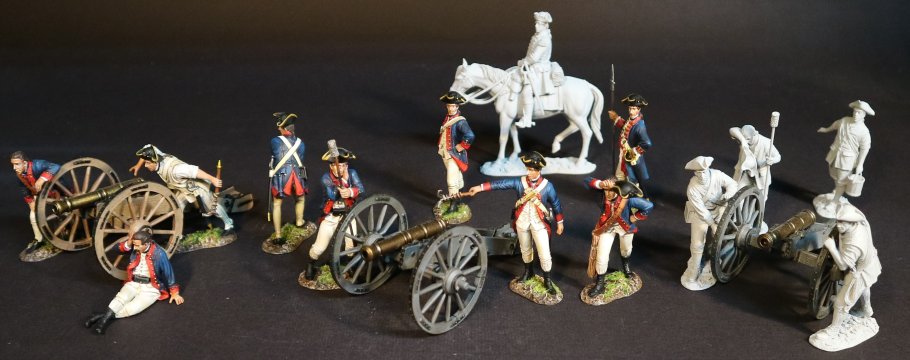
The Continental Army’s growing pains through the first years of the war caused Washington considerable irritation. Professional armies cannot be developed overnight, and the fits and starts of the Continental Army’s creation is illustrated most clearly in the establishment of the artillery. The United States had to build its artillery from scratch, but impressively by 1778 this branch of service was well regulated and effective.
Although the Continental Army’s artillery units were not affected by the uniform regulations as much as the infantry had been, there were still several different uniforms pre the 1778 regulations.
The change imposed on the artillery by the regulations was to make all four of the Continental regiments uniform in appearance as a branch of service and do away with distinctions between the regiments. This happened in October 1779.
Prior to this, the artillery arm of the Continental army had been noted as mainly wearing dark blue coats, usually faced red.
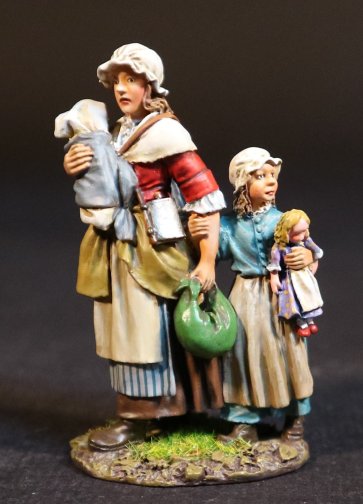
MOLLY PITCHER
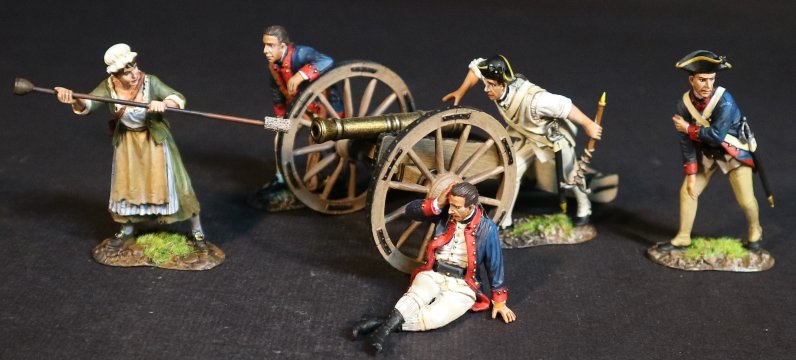
The wife of William Hays of Proctor’s Artillery Regiment, Mary was in her mid twenties, common in appearance but compact and strong. There was probably little to distinguish her from the many hundreds of other women attached to the army, except exchanging the role of water bearer ( a role performed by many camp followers of the army during combat) for that of combatant. Thus Mary Ludwig Hays became “Molly Pitcher”.
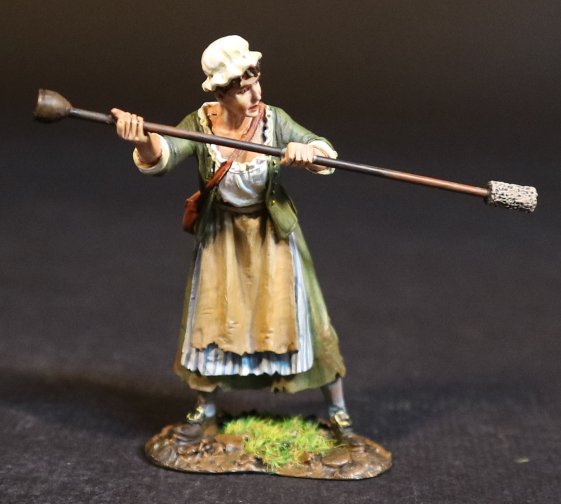
AWIART-05
THE AMERICAN WAR OF INDEPENDENCE 1775-1783,
THE AMERICAN ARTILLERY,
“MOLLY PITCHER”
She had joined her husband at the Army’s winter camp at Valley Forge in 1777, and was present at the Battle of Monmouth, where she served as a water carrier. Her husband fell and she took his place swabbing and loading the cannon, and was later commended by George Washington.
The incident was recorded by Joseph Plumb Martin in his memoir published in 1830.
“A woman whose husband belonged to the artillery and who was attached to a piece in the engagement, attended with her husband at the piece the whole time. While in the act of reaching a cartridge and having one of her feet as far before the other as she could step, a cannon shot from the enemy passed directly between her legs without doing any more damage than carrying away all the lower part of her petticoat. Looking at it with apparent unconcern, she observed that it was lucky it did not pass a little higher, for in that case it might have carried away something else, and continued her work.”
Molly Pitcher has become a symbol of women’s contributions to the American Revolutionary War. While her story has been romanticized and may contain elements of legend, it highlights the vital roles women played in supporting the war effort.
Countless more women whose names we may never know, served at the battlefront as nurses, cooks, laundresses and camp followers.
Historian Holly Mayer estimates that perhaps 7,000 women accompanied the American troops during the war.
George Washington was to complain in 1777 that “the multitude of women in particular… are a clog upon every movement”. But he knew that the soldiers would desert without them, and that their labour was necessary.
The name “Molly Pitcher” has come to represent all women who served in various capacities during the war.
THE RAID ON ST. FRANCIS 1759
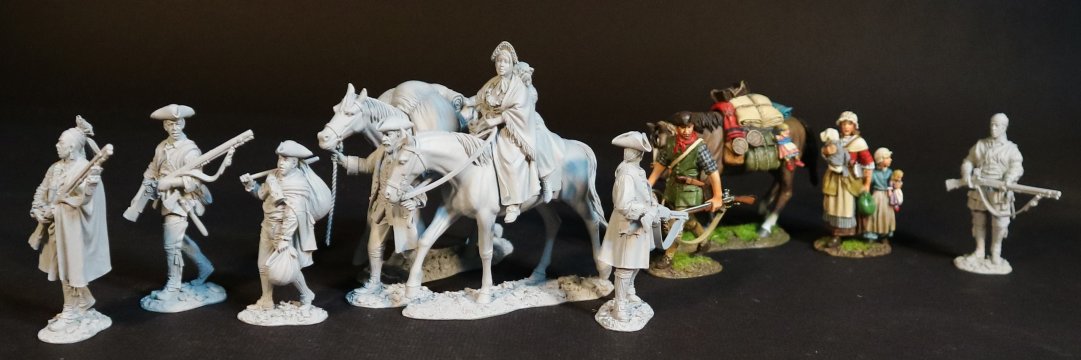
ROGER’S RANGERS
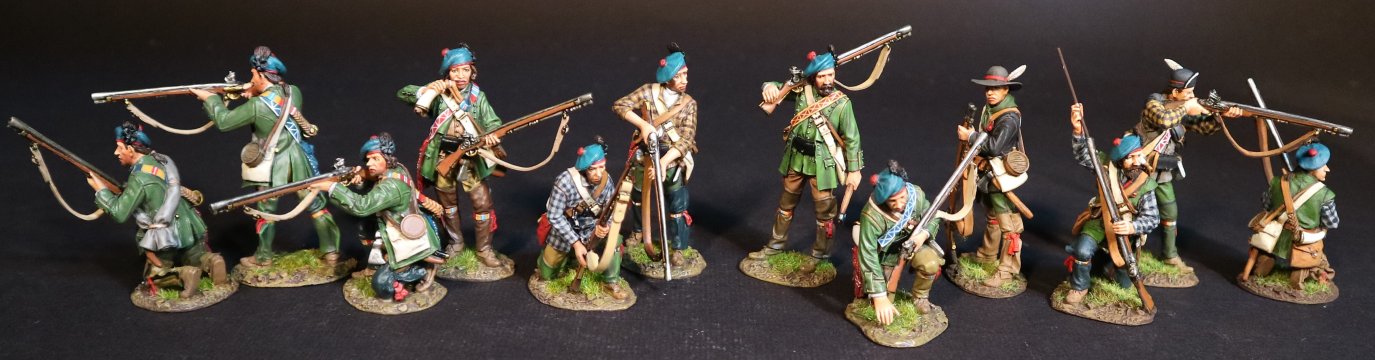
Roger’s Rangers was a company of soldiers form the Province of New Hampshire
raised by Major Robert Rogers and attached to the British Army during the Seven Year’s War (French and Indian War).
The unit was quickly adopted into the New England Colonies army as an independent ranger company. Rogers was inspired by colonial Frontiersman Ranger groups across North America and the teachings of unconventional warfare from Ranger such as Benjamin Church.
Robert Rogers trained and commanded his own rapidly deployable light infantry force , which was tasked mainly with reconnaissance as well as conducting special operations against distant targets.Their tactics were built on earlier Colonial precedents and were codified for the first time by Rogers as his 28 “Rules of Ranging”.
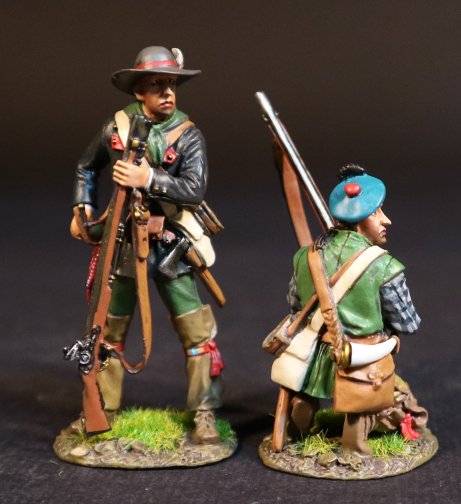
RR-35
THE EIGHTEENTH CENTURY COLLECTION
THE RAID ON ST. FRANCIS 1759,
ROGER’S RANGERS
The tactics proved remarkably effective, so much so that the initial company was expanded into a ranging corps of more than a dozen companies (containing as many as 1,200-1,400 men at its peak). The ranger corps became the chief scouting arm of British Crown forces by the late 1750s.The British forces in America valued Roger’s Rangers for their ability to gather intelligence about the enemy.They were disbanded in 1761.
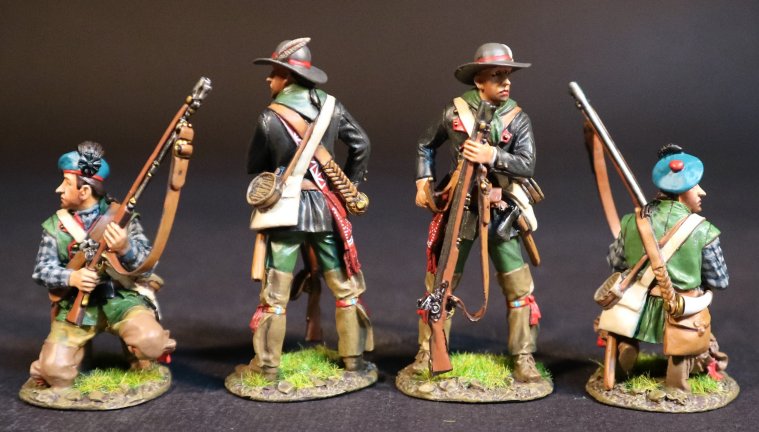
RR-35D
THE EIGHTEENTH CENTURY COLLECTION
THE RAID ON ST. FRANCIS 1759,
ROGER’S RANGERS
**PLEASE CONTACT YOUR LOCAL DEALER TO PLACE YOUR PRE-ORDERS**
THE AMERICAN WAR OF INDEPENDENCE
THE BATTLE OF BUNKER HILL, 17th JUNE 1775.
THE ASSAULT ON THE REDOUBT AT BREED’S HILL
Boston was the third largest town in North America, and stood on a Peninsula connected to the mainland by a neck just wide enough to cross at high tide. The harbour, large enough to be strategically significant, and central to the town’s economy, was formed by a chain of islands stretching out to sea, guarded by reefs and ledges.
North west of Boston was Charlestown, a largely rural peninsula one and a half miles long. Charlestown stood at the south east corner with three hills behind it. Bunker’s Hill, nearest the neck of the Peninsula, Breed’s Hill 200 yards above the town and Moulton’s Hill to the north east.
On the 16th June 1775, 3 detachments from Massachusetts regiments under the command of Colonel William Prescott and engineer Captain Richard Gridley, crossed the Charlestown neck and arrived at Bunker Hill.
Captain Richard Gridley and Prescott disagreed as to where they should locate their defense. Some work was performed on Bunker Hill, but Breed’s Hill was closer to Boston and viewed as being more defensible, and they decided to build their primary redoubt there.
Prescott and his men began digging a square fortification about 130 ft a side with ditches and earthen walls. The walls of the redoubt were about 6 feet high.
Work began at midnight, and around 4am one of the British warships spotted the earthworks on Breed’s Hill and opened fire.
The British command agreed that the works posed a significant threat, but were at this time sufficiently incomplete and isolated to offer a chance of a successful attack.
The original British plan was to bypass the redoubt to the north and capture Bunker’s Hill and the neck of the peninsula, thus isolating the redoubt on Breed’s Hill.
The Americans repulsed two British assaults, with significant British casualties. The British captured the redoubt on their third assault, after the defenders had run out of ammunition. The colonists retreated over Bunker Hill, leaving the British finally in control of the Peninsula.
The battle was a tactical victory for the British, but it proved to be a sobering experience for them; they incurred many more casualties than the Americans had sustained, including many officers. The battle had demonstrated that inexperienced militia were able to stand up to regular army troops in battle. Subsequently, the battle discouraged the British from any further frontal attacks against well defended front lines. American casualties were much fewer, although their losses included General Joseph Warren, and Major Andrew McClary, the final casualty of the battle.
BRITISH MARINES
The Marines, which only became “Royal Marines” in 1802, were the Royal Navy’s private army, administered by the Admiralty and controlled by senior naval officers. The rank and file were volunteers and wore army style uniforms and equipment. However they were trained to serve on warships and undertake amphibious operations. The 50 companies, shared between Chatham, Portsmouth and Plymouth, were not regimented, and detachments, or in some cases individual replacements were assigned on an ad hoc basis.
The first Marines sent to Boston were to form a battalion of 600 men under Major Pitcairn, but by March only 336 were present, as they soon became an object of inter service rivalry over pay, food and conditions. Although initially physically inferior to their army comrades, and short of essential equipment for service on land, incessant drilling and regular marches into the countryside soon created a fine unit.
Another group of over 700 men arrived in May, and the whole force formed two battalions, with grenadier and light companies.
The 1st and 2nd Marines were to play an important part in the assault on the southern defences of the Breed’s Hill redoubt.
MAJOR ROBERT ROSS
Major Robert Ross was born in 1740, and was commissioned on the 17th June 1756 as a Lieutenant of 86 Company in Chatham. He was to serve at the Siege of Louisbourg in 1758, and the capture of Quebec in 1759.
In 1773 was dispatched to America and appointed commander of 5 Company 1st Battalion. At the Battle of Bunker Hill Captain Ross was singled out for commendation in leading 5 Company during the assault on Breeds Hill.
MBHL-24
THE AMERICAN WAR OF INDEPENDENCE 1775-1783,
THE BATTLE OF BUNKER HILL, JUNE 17th 1775,
THE ASSAULT ON THE REDOUBT AT BREED’S HILL,
BRITISH MARINES,
CAPTAIN ROBERT ROSS
In August 1779 he was taken prisoner by the French in the English Channel, and was later released.
After two years serving in the Mediterranean and the West Indies he was promoted to brevet major.
On the 12th October 1786 was appointed commandant of the NSW Marine Corps detachment, and later on the 24th October 1786 became Lieutenant Governor of New South Wales.
He was to return to England in 1792 where he became a recruiting officer.
His death is recorded st Brampton on the 9th June 1794.
THE AMERICAN WAR OF INDEPENDENCE
AMERICAN ARTILLERY
The Continental Army’s growing pains through the first years of the war caused Washington considerable irritation. Professional armies cannot be developed overnight, and the fits and starts of the Continental Army’s creation is illustrated most clearly in the establishment of the artillery. The United States had to build its artillery from scratch, but impressively by 1778 this branch of service was well regulated and effective.
Although the Continental Army’s artillery units were not affected by the uniform regulations as much as the infantry had been, there were still several different uniforms pre the 1778 regulations.
The change imposed on the artillery by the regulations was to make all four of the Continental regiments uniform in appearance as a branch of service and do away with distinctions between the regiments. This happened in October 1779.
Prior to this, the artillery arm of the Continental army had been noted as mainly wearing dark blue coats, usually faced red.
MOLLY PITCHER
The wife of William Hays of Proctor’s Artillery Regiment, Mary was in her mid twenties, common in appearance but compact and strong. There was probably little to distinguish her from the many hundreds of other women attached to the army, except exchanging the role of water bearer ( a role performed by many camp followers of the army during combat) for that of combatant. Thus Mary Ludwig Hays became “Molly Pitcher”.
AWIART-05
THE AMERICAN WAR OF INDEPENDENCE 1775-1783,
THE AMERICAN ARTILLERY,
“MOLLY PITCHER”
She had joined her husband at the Army’s winter camp at Valley Forge in 1777, and was present at the Battle of Monmouth, where she served as a water carrier. Her husband fell and she took his place swabbing and loading the cannon, and was later commended by George Washington.
The incident was recorded by Joseph Plumb Martin in his memoir published in 1830.
“A woman whose husband belonged to the artillery and who was attached to a piece in the engagement, attended with her husband at the piece the whole time. While in the act of reaching a cartridge and having one of her feet as far before the other as she could step, a cannon shot from the enemy passed directly between her legs without doing any more damage than carrying away all the lower part of her petticoat. Looking at it with apparent unconcern, she observed that it was lucky it did not pass a little higher, for in that case it might have carried away something else, and continued her work.”
Molly Pitcher has become a symbol of women’s contributions to the American Revolutionary War. While her story has been romanticized and may contain elements of legend, it highlights the vital roles women played in supporting the war effort.
Countless more women whose names we may never know, served at the battlefront as nurses, cooks, laundresses and camp followers.
Historian Holly Mayer estimates that perhaps 7,000 women accompanied the American troops during the war.
George Washington was to complain in 1777 that “the multitude of women in particular… are a clog upon every movement”. But he knew that the soldiers would desert without them, and that their labour was necessary.
The name “Molly Pitcher” has come to represent all women who served in various capacities during the war.
THE RAID ON ST. FRANCIS 1759
ROGER’S RANGERS
Roger’s Rangers was a company of soldiers form the Province of New Hampshire
raised by Major Robert Rogers and attached to the British Army during the Seven Year’s War (French and Indian War).
The unit was quickly adopted into the New England Colonies army as an independent ranger company. Rogers was inspired by colonial Frontiersman Ranger groups across North America and the teachings of unconventional warfare from Ranger such as Benjamin Church.
Robert Rogers trained and commanded his own rapidly deployable light infantry force , which was tasked mainly with reconnaissance as well as conducting special operations against distant targets.Their tactics were built on earlier Colonial precedents and were codified for the first time by Rogers as his 28 “Rules of Ranging”.
RR-35
THE EIGHTEENTH CENTURY COLLECTION
THE RAID ON ST. FRANCIS 1759,
ROGER’S RANGERS
The tactics proved remarkably effective, so much so that the initial company was expanded into a ranging corps of more than a dozen companies (containing as many as 1,200-1,400 men at its peak). The ranger corps became the chief scouting arm of British Crown forces by the late 1750s.The British forces in America valued Roger’s Rangers for their ability to gather intelligence about the enemy.They were disbanded in 1761.
RR-35D
THE EIGHTEENTH CENTURY COLLECTION
THE RAID ON ST. FRANCIS 1759,
ROGER’S RANGERS
**PLEASE CONTACT YOUR LOCAL DEALER TO PLACE YOUR PRE-ORDERS**