


- Joined
- Feb 2, 2011
- Messages
- 2,428
NEW RELEASES FOR MARCH 2026
THE GOLD RUSH
A gold rush or gold fever is a discovery of gold that brings an onrush of miners seeking their fortune.
Major gold rushes took place in the 19th century in the United States, Canada, Australia, Greece, New Zealand, Brazil, Chile, and South Africa.
Gold rushes were typically marked by a general buoyant feeling of a “free for all”, in which any single individual might become abundantly wealthy almost instantly, as expressed in the California Dream!
Gold rushes helped spur waves of immigration that often led to the permanent settlement of new regions. Activities propelled by gold rushes define significant aspects of the culture of the Australian and North American frontiers.
At a time when the world’s money supply was based on gold, the newly mined gold provided economic stimulus far beyond the goldfields, feeding into local and wider economic booms.
The California Gold Rush of 1848-1855 in the Sierra Nevada captured the popular imagination, and led to an influx of gold miners, which led to California’s rapid industrialization, as businesses sprung up to serve the increased population and financial institutions to handle the increased wealth.
One of these political institutions was statehood; the need for new laws in a sparsely governed land led to the state’s rapid entry into the Union in 1850.
Various gold rushes occurred in Australia over the second half of the 19th Century. The most significant of these although not the only ones, were the New South Wales gold rush and Victorian gold rush in 1851, and the Western Australia gold rushes of the 1890’s.
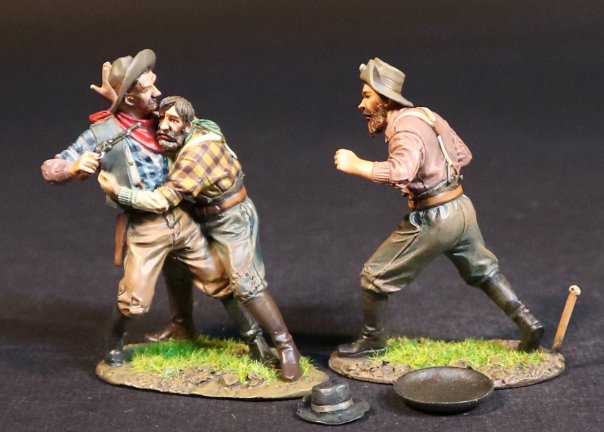
WSP-130
THE GOLD RUSH,
“THE ARGUMENT”
These were highly significant to their respective colonies political and economic development as they brought many immigrants, and promoted massive government spending on infrastructure to support the new arrivals who came looking for gold.
While some found their fortune, those who did not often remained in the colonies and took advantage of extremely liberal land laws to take up farming.
One of the last “great gold rushes” was the Klondike gold rush in the Yukon Territory in 1896 – 1899. This gold rush is featured in the novels of Jack London, and in Charlie Chaplin’s film “The Gold Rush”.
The main goldfield was along the south flank of the Klondike River near its confluence with the Yukon River, close to what was to become Dawson city in the Yukon Territory. It also helped to open up the relatively new US possession of Alaska to exploration and settlement, and promoted the discovery of other gold finds.
THUNDER ON THE PLAINS
THE BLACK HILL WARS 1876-1877
THE BATTLE OF THE ROSEBUD, 17th JUNE 1876
UNITED STATES CAVALRY
As settlers spread westward across North America after 1780, armed conflicts increased in size, duration, and intensity between settlers and various Indian and First Nation tribes.
In 1875, the Great Sioux War of 1876-77 erupted when the Dakota gold rush penetrated the Black Hills. The U.S government decided to stop evicting trespassers from the Black Hills and offered to buy the land from the Sioux. When they refused, the US government decided instead to take the land and gave the Lakota until January 31st, 1876 to return to reservations.
An United States cavalry regiment in 1876 consisted of 12 companies.
A cavalry company, at full strength had 3 officers and 70 enlisted men.
The US cavalry of 1876 used Lt. Col. Emory Upton’s Cavalry Tactics, which was an unified system of drill, which was compatible among the cavalry, infantry and artillery. This meant an officer could move from one branch of service to another.
Upton’s tactics incorporated a “set of fours” as the basic, or smallest, cavalry unit or squad. This was designed to simplify operations, increase speed, and eliminate cumbersome manoeuvres.
Dismounted skirmishing became the main cavalry mode of engagement with the enemy, which facilitated the dispersal of men on a firing line.
On campaign and in battle, cavalrymen did not always perform as mounted skirmishers but rather served as mounted infantry. By dismounting and kneeling under fire, the trooper presented a much smaller target for the enemy and could take aim much more accurately.
The preparatory command “to fight on foot”, followed by “As skirmishers”, required each cavalryman to dismount and deploy along a firing line at 5yd intervals, with 15yd gaps between each set of four men.
Odd numbered skirmishers in each set of four fired a round on command and then reloaded as even numbered skirmishers fired on order. Each man then continued to fire roughly in an odd-even sequence without regard to the others until “Cease fire” command was given. Skirmish tactics could be employed by the platoon, company, battalion or even at regimental level.
Dismounted skirmishing required one of every four men, designated as a horse holder, to remain with the horses of the other three. Horse holders retired to a safe position in the rear.
On 28th May 1876, Brigadier General George Crook assumed direct command of the Bighorn and Yellowstone Expedition at Fort Fetterman. Crook had gathered a strong force. Leaving Fort Fetterman on 29th May the 1,051man column consisted of 15 companies from the 2nd and 3rd Cavalry, 5 companies from the 4th and 9th Infantry, 250 mules and 106 wagons.
On the 14th June, the column was joined by 261 Shoshone and Crow allies.
Based on intelligence reports Crook ordered his entire force to prepare for a quick march. Each man was to carry only 1 blanket, 100 rounds of ammunition, and 4 days rations. The wagon train would be left at Goose Creek, and the infantry would be mounted on the pack mules.
On 17 June, Crook's column set out at 0600, marching northward along the south fork of Rosebud Creek. The Crow and Shoshone scouts were particularly apprehensive. Although the column had not yet encountered any sign of Indians, the scouts seemed to sense their presence. The soldiers, particularly the mule-riding infantry, seemed fatigued from the early start and the previous day's 35-mile (56 km) march. Accordingly, Crook stopped to rest his men and animals at 0800. Although he was deep in hostile territory, Crook made no special dispositions for defense. His troops halted in their marching order. The Cavalry battalions led the column, followed by the battalion of mule-borne foot soldiers, and a provisional company of civilian miners and packers brought up the rear.
The Crow and Shoshone scouts remained alert while the soldiers rested. Several minutes later, the soldiers heard the sound of intermittent gunfire coming from the bluffs to the north. As the intensity of fire increased, a scout rushed into the camp shouting, "Lakota, Lakota!" The Battle of the Rosebud had started. By 0830, the Sioux and Cheyenne had hotly engaged Crook's Indian allies on the high ground north of the main body. Heavily outnumbered, the Crow and Shoshone scouts fell back toward the camp, but their fighting withdrawal gave Crook time to deploy his forces. Rapidly firing soldiers drove off the attackers but used up much of the ammunition meant for use later in the campaign. Low on ammunition and with numerous wounded, the General returned to his post.
Historians debate whether Crook’s pressing on could have prevented the killing of the five companies of the 7th Cavalry Regiment led by George Armstrong Custer at the Battle of the Little Bighorn.
US ARMY FRONTIER SCOUTS
The role of the frontier scout was vital during the period of expansion between 1840 and 1890. These men possessed a priceless knowledge of the geography, people and characteristics of the great American hinterland. They were to have a larger influence on the pace of settlement and control of the American west than any other single factor.
CALIFORNIA JOE
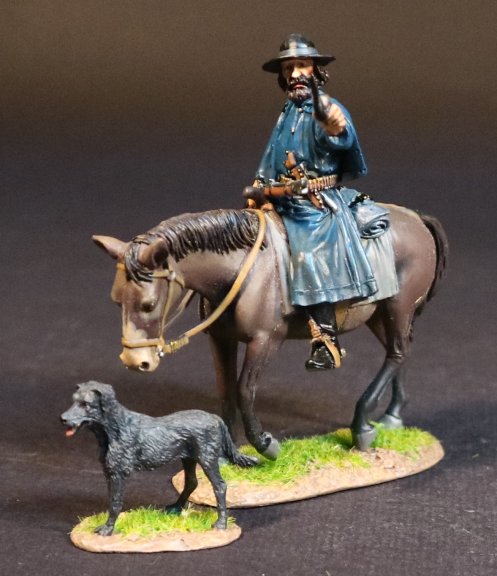
RSBUD-36
THUNDER ON THE PLAINS
THE BLACK HILL WARS 1876-1877
THE BATTLE OF THE ROSEBUD, 17th JUNE 1876,
UNITED STATES CAVALRY,
ARMY FRONTIER SCOUTS,
“CALIFORNIA JOE”
General Sheridan was to describe “California Joe” as an “invaluable guide and Indian fighter”. Born Moses Embree Milner in Kentucky during 1829, he acquired his nickname after taking part in the California gold rush of 1849.
He served with both Kit Carson and Jim Bridger during the civil war and subsequently became a scout in the Indian Wars.
He was to serve as a scout under both Generals Custer and Crook between 1868 and 1876.
Custer was apparently so impressed with his tracking skills that he appointed him chief of scouts.
California Joe was eventually killed by a rival at Fort Robinson, Nebraska Territory.
Please Contact your Dealer to pre-order!
THE GOLD RUSH
A gold rush or gold fever is a discovery of gold that brings an onrush of miners seeking their fortune.
Major gold rushes took place in the 19th century in the United States, Canada, Australia, Greece, New Zealand, Brazil, Chile, and South Africa.
Gold rushes were typically marked by a general buoyant feeling of a “free for all”, in which any single individual might become abundantly wealthy almost instantly, as expressed in the California Dream!
Gold rushes helped spur waves of immigration that often led to the permanent settlement of new regions. Activities propelled by gold rushes define significant aspects of the culture of the Australian and North American frontiers.
At a time when the world’s money supply was based on gold, the newly mined gold provided economic stimulus far beyond the goldfields, feeding into local and wider economic booms.
The California Gold Rush of 1848-1855 in the Sierra Nevada captured the popular imagination, and led to an influx of gold miners, which led to California’s rapid industrialization, as businesses sprung up to serve the increased population and financial institutions to handle the increased wealth.
One of these political institutions was statehood; the need for new laws in a sparsely governed land led to the state’s rapid entry into the Union in 1850.
Various gold rushes occurred in Australia over the second half of the 19th Century. The most significant of these although not the only ones, were the New South Wales gold rush and Victorian gold rush in 1851, and the Western Australia gold rushes of the 1890’s.
WSP-130
THE GOLD RUSH,
“THE ARGUMENT”
These were highly significant to their respective colonies political and economic development as they brought many immigrants, and promoted massive government spending on infrastructure to support the new arrivals who came looking for gold.
While some found their fortune, those who did not often remained in the colonies and took advantage of extremely liberal land laws to take up farming.
One of the last “great gold rushes” was the Klondike gold rush in the Yukon Territory in 1896 – 1899. This gold rush is featured in the novels of Jack London, and in Charlie Chaplin’s film “The Gold Rush”.
The main goldfield was along the south flank of the Klondike River near its confluence with the Yukon River, close to what was to become Dawson city in the Yukon Territory. It also helped to open up the relatively new US possession of Alaska to exploration and settlement, and promoted the discovery of other gold finds.
THUNDER ON THE PLAINS
THE BLACK HILL WARS 1876-1877
THE BATTLE OF THE ROSEBUD, 17th JUNE 1876
UNITED STATES CAVALRY
As settlers spread westward across North America after 1780, armed conflicts increased in size, duration, and intensity between settlers and various Indian and First Nation tribes.
In 1875, the Great Sioux War of 1876-77 erupted when the Dakota gold rush penetrated the Black Hills. The U.S government decided to stop evicting trespassers from the Black Hills and offered to buy the land from the Sioux. When they refused, the US government decided instead to take the land and gave the Lakota until January 31st, 1876 to return to reservations.
An United States cavalry regiment in 1876 consisted of 12 companies.
A cavalry company, at full strength had 3 officers and 70 enlisted men.
The US cavalry of 1876 used Lt. Col. Emory Upton’s Cavalry Tactics, which was an unified system of drill, which was compatible among the cavalry, infantry and artillery. This meant an officer could move from one branch of service to another.
Upton’s tactics incorporated a “set of fours” as the basic, or smallest, cavalry unit or squad. This was designed to simplify operations, increase speed, and eliminate cumbersome manoeuvres.
Dismounted skirmishing became the main cavalry mode of engagement with the enemy, which facilitated the dispersal of men on a firing line.
On campaign and in battle, cavalrymen did not always perform as mounted skirmishers but rather served as mounted infantry. By dismounting and kneeling under fire, the trooper presented a much smaller target for the enemy and could take aim much more accurately.
The preparatory command “to fight on foot”, followed by “As skirmishers”, required each cavalryman to dismount and deploy along a firing line at 5yd intervals, with 15yd gaps between each set of four men.
Odd numbered skirmishers in each set of four fired a round on command and then reloaded as even numbered skirmishers fired on order. Each man then continued to fire roughly in an odd-even sequence without regard to the others until “Cease fire” command was given. Skirmish tactics could be employed by the platoon, company, battalion or even at regimental level.
Dismounted skirmishing required one of every four men, designated as a horse holder, to remain with the horses of the other three. Horse holders retired to a safe position in the rear.
On 28th May 1876, Brigadier General George Crook assumed direct command of the Bighorn and Yellowstone Expedition at Fort Fetterman. Crook had gathered a strong force. Leaving Fort Fetterman on 29th May the 1,051man column consisted of 15 companies from the 2nd and 3rd Cavalry, 5 companies from the 4th and 9th Infantry, 250 mules and 106 wagons.
On the 14th June, the column was joined by 261 Shoshone and Crow allies.
Based on intelligence reports Crook ordered his entire force to prepare for a quick march. Each man was to carry only 1 blanket, 100 rounds of ammunition, and 4 days rations. The wagon train would be left at Goose Creek, and the infantry would be mounted on the pack mules.
On 17 June, Crook's column set out at 0600, marching northward along the south fork of Rosebud Creek. The Crow and Shoshone scouts were particularly apprehensive. Although the column had not yet encountered any sign of Indians, the scouts seemed to sense their presence. The soldiers, particularly the mule-riding infantry, seemed fatigued from the early start and the previous day's 35-mile (56 km) march. Accordingly, Crook stopped to rest his men and animals at 0800. Although he was deep in hostile territory, Crook made no special dispositions for defense. His troops halted in their marching order. The Cavalry battalions led the column, followed by the battalion of mule-borne foot soldiers, and a provisional company of civilian miners and packers brought up the rear.
The Crow and Shoshone scouts remained alert while the soldiers rested. Several minutes later, the soldiers heard the sound of intermittent gunfire coming from the bluffs to the north. As the intensity of fire increased, a scout rushed into the camp shouting, "Lakota, Lakota!" The Battle of the Rosebud had started. By 0830, the Sioux and Cheyenne had hotly engaged Crook's Indian allies on the high ground north of the main body. Heavily outnumbered, the Crow and Shoshone scouts fell back toward the camp, but their fighting withdrawal gave Crook time to deploy his forces. Rapidly firing soldiers drove off the attackers but used up much of the ammunition meant for use later in the campaign. Low on ammunition and with numerous wounded, the General returned to his post.
Historians debate whether Crook’s pressing on could have prevented the killing of the five companies of the 7th Cavalry Regiment led by George Armstrong Custer at the Battle of the Little Bighorn.
US ARMY FRONTIER SCOUTS
The role of the frontier scout was vital during the period of expansion between 1840 and 1890. These men possessed a priceless knowledge of the geography, people and characteristics of the great American hinterland. They were to have a larger influence on the pace of settlement and control of the American west than any other single factor.
CALIFORNIA JOE
RSBUD-36
THUNDER ON THE PLAINS
THE BLACK HILL WARS 1876-1877
THE BATTLE OF THE ROSEBUD, 17th JUNE 1876,
UNITED STATES CAVALRY,
ARMY FRONTIER SCOUTS,
“CALIFORNIA JOE”
General Sheridan was to describe “California Joe” as an “invaluable guide and Indian fighter”. Born Moses Embree Milner in Kentucky during 1829, he acquired his nickname after taking part in the California gold rush of 1849.
He served with both Kit Carson and Jim Bridger during the civil war and subsequently became a scout in the Indian Wars.
He was to serve as a scout under both Generals Custer and Crook between 1868 and 1876.
Custer was apparently so impressed with his tracking skills that he appointed him chief of scouts.
California Joe was eventually killed by a rival at Fort Robinson, Nebraska Territory.
Please Contact your Dealer to pre-order!
