
DECEMBER 2025 FIGURE NEWS (1 Viewer)

Gunn Miniatures

Command Sergeant Major
Joined
Jun 18, 2009
Messages
2,853

dec figure news cover.jpg

Welcome to the latest Jump The Gunn Newsletter, December figures are now here for all to see, these should be available from December 12th 2025 or thereabouts.

As always we start off in historical order, so let's start off with the new Napoleonic range which we could not have done without the expert help of John O'Brien in Australia and local UK historian Tim Saunders, this really was a joint international cooperation! There will be another version of the standing and kneeling riflemen to follow as these will likely be the most popular.

Next year should see Napoleonic artillery and French cavalry.
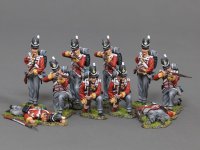
 
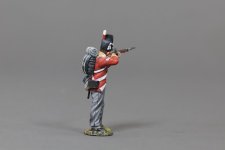
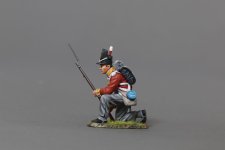
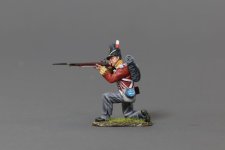
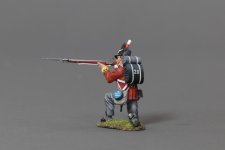
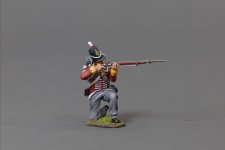
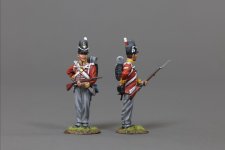
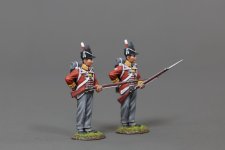
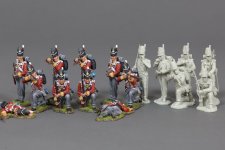
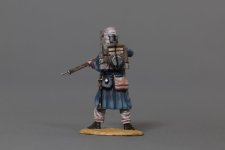
Napoleonic Wars. 28th (North Gloucestershire) Regiment of Foot

Napoleon cover.jpg


Raised in 1694, the 28th (North Gloucestershire) Regiment of Foot was a line regiment of the British Army. This is a new regiment for Thomas Gunn, and the 28th Regiment has a long history. Being in the front line from the late 1600s through to the late 1800s, it was amalgamated with the 61st (South Gloucestershire) Regiment of Foot to form the Gloucestershire Regiment.
In 1801, the regiment formed part of the British expeditionary force that landed in Egypt to oppose Napoleon's Army. On 21st March 1801, during the Battle of Alexandria, French cavalry broke through the British lines, formed up behind the regiment, and charged. Still heavily engaged to their front, the order was given "Rear Rank, 28th! Right About Face", and standing thus in two ranks, back to back, the regiment successfully defended itself. After the battle, the regiment began wearing a badge on the back as well as the front of the headdress to commemorate their action, a unique distinction in the British Army that was officially sanctioned in 1830.
The regiment was involved throughout the Napoleonic wars. Fighting in Denmark in 1807, landing in Portugal in 1808, taking part in the Battle of Corunna on 16 January 180, before being evacuated from the peninsula the next day, with a detachment remaining behind and fought at the Battle of Talavera in July 1809. The remainder of the regiment went on to take part in the disastrous Walcheren Campaign in 1809.

Returning to the Peninsula in 1810. The regiment saw action at the Battle of Barrosa, the Battle of Albuera and the Battle of Arroyo dos Molinos in 1811. In 1813 the regiment fought at the Battle of Vitoria and the Battle of the Pyrenees, then pursued the French Army into France and fought at the Battle of Nivelle and the Battle of the Nive. Followed by the Battle of Orthez and Battle of Toulouse in 1814.

The regiment was one of the many Peninsula veteran regiments which were available for the 100 Days campaign and fought at the Battle of Quatre Bras and the Battle of Waterloo, as part of the 8th Brigade commanded by James Kempt, in June 1815. Because of its actions in this campaign, the regiment earned a distinguished mention in the dispatches of the Duke of Wellington.

Collectors have a wide choice of Napoleonic battles and conflicts, from Egypt, the Low Countries, the Peninsula War and the 1815 campaign. We are releasing 8 sets and 10 figures in December 2025, to be followed by a further 7 figures in early 2026, which will include Flagbearers, Officers, Sergeants, Drummers and Artillery.

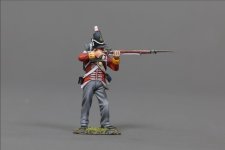
NAP60A. Standing Firing - Private
NAP60B. Standing Firing - Corporal
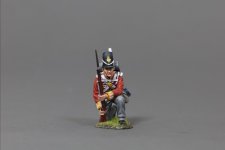
NAP61A. Kneeling Repel - Private
NAP61B. Kneeling Repel - Corporal
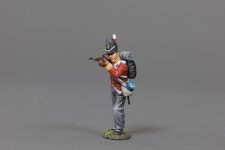
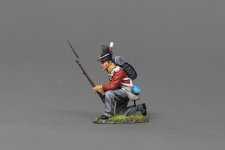
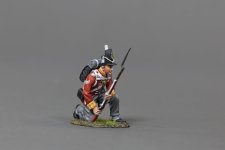
NAP62A. Kneeling Firing - Private
NAP62B. Kneeling Firing - Corporal
All figures are priced at $50/£45 for a single figure

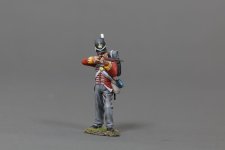
NAP63A/B. Reloading [#1] Two Soldiers - Corporal & Private
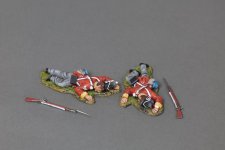
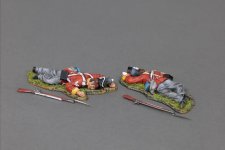
NAP66. Dead Soldiers - Corporal & Private
Double Figure Sets are priced at $90/£83 for the 2 figures in a single box
 
French Foreign Legion


french foreign legion cover.jpg


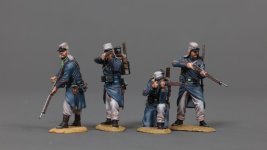
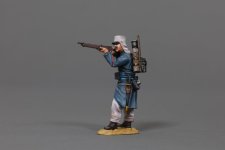
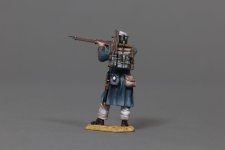
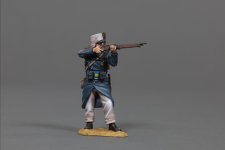
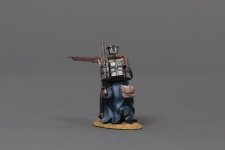
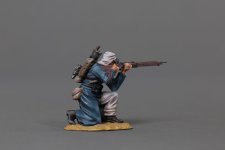
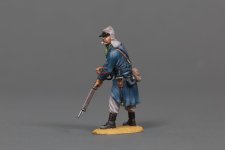
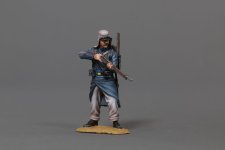
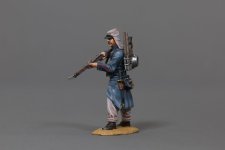
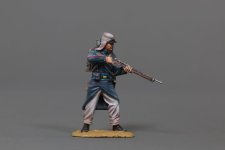
FFL052B. Legionnaire - Standing Firing [2]
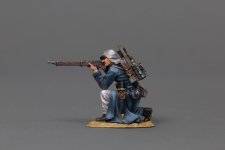
FFL053B. Legionnaire - Kneeling Firing [2]
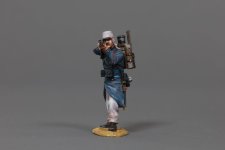
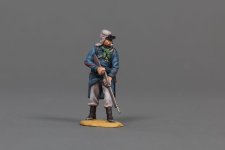
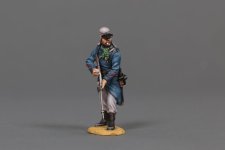
FFL068. Legionnaire – The Old Sweat
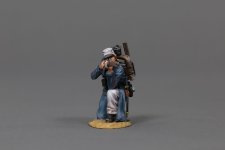
FFL069. Legionnaire – Ready
All Legionnaires are $55/£50 per figure.

Return to the Foreign Legion

The French Foreign Legion, one of the world’s most iconic military forces. The Foreign Legion was created by King Louis Philippe, on 10 March 1831 to allow the incorporation of foreign nationals into the French Army from the foreign regiments of the Kingdom of France. The establishment of the new regiment specified that the foreigners recruited could only serve outside France. Created to fight "outside mainland France", the Foreign Legion was stationed in Algeria. The Foreign Legion was initially divided into six "national battalions" (Swiss, Poles, Germans, Italians, Spanish, and Dutch-Belgian). Smaller national groups, such as ten Englishmen recorded in December 1832, appear to have been placed randomly.
In this recent batch we have remade 2 of our previous sold out Legionnaires, but have added backpacks, medals to the chest of some, weathered their kepis and rolled up the trousers on others. The 'Old Sweat' has the addition of a rather chic looking scarf and cigarette to give him that look of someone who has see it all before and is not phased by anything that lies ahead.
 
FFL068. Legionnaire – Old Sweat. Cigarette in mouth, unofficial green spotted scarf, this veteran has just taken a shot and is pulling back the rifle bolt while scanning a new target.


FFL068 1.jpg


FFL068 2.jpg


FFL068 3.jpg
 
WW2 German 6th SS Gebirgsjäger
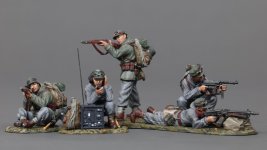
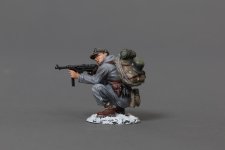
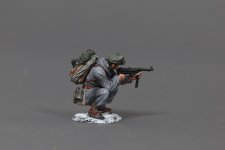
New Releases from the 6th SS, all our figures have the unit logo adorning their right arm.

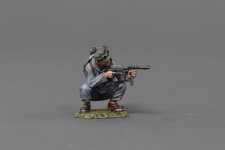
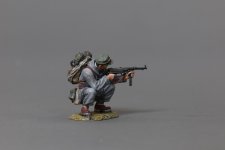
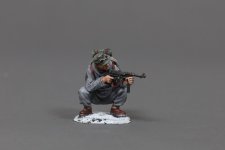
SS190A. Squatting MP40 - SS Gebirgsjäger– Summer
SS190B. Squatting MP40 - SS Gebirgsjäger- Winter
Figures are $55/£50 each

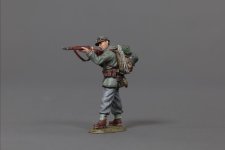
SS191A. Standing Firing SS Gebirgsjäger – Summer
SS191B. Standing Firing SS Gebirgsjäger - Winter
Figures are $55/£50 each

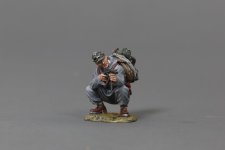
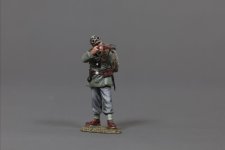
SS192A. Radio Operator SS Gebirgsjäger – Summer
SS192B. Radio Operator SS Gebirgsjäger Winter
Radio Operator figures are $57/£52.50 each

The 6th SS Mountain Division was formed in February 1941 as the SS Battle Group North (SS-Kampfgruppe Nord) in southern Norway before being upgraded and renamed the SS Division Nord in preparation for Operation Barbarossa and holds the unique distinction of being the only German SS unit to have fought in the Artic Circle.

Initially the unit had low combat effectiveness, in the second half of 1941 the division was effectively destroyed by the Russians during Operation Arctic Fox. After taking massive losses in its first operation the Nord Division was entirely rebuilt starting from late 1941. The SS Division Nord remained in Finland and northern Russia, where most of its personnel were replaced over the course of 1942 and 1943. From that point they consisted of combat veterans and graduates of the Waffen-SS Mountain warfare school. With the improvement in its combat capability, the division fought off multiple Russian attacks. It was also renamed again as the 6th SS Mountain Division Nord. After Finland signed an armistice with Russia in 1944. The Nord Division broke through lines of Soviet and Finnish troops in a fighting retreat back to Norway and eventually was stationed in Denmark.

In late 1944 the division was redeployed to the Western Front against the Western Allied invasion of Germany. Following the failure of the Ardennes campaign the 6th SS Mountain Division took part in Operation Nordwind, an attack on the U.S. 7th Army in southeastern France, which held a relatively weak position in the Allied line. On January 1st 1945 the offensive commenced, and the lead elements of the Nord Division, known as Kampfgruppe Schreiber after its commander, took part in the attack. The Nord Division troops the town of Wingen-sur-Moder, but on January 6th 1945, US troops captured towns to the rear and encircled the Nord Division. After Operation Nordwind was called off the Division broke through the Americans lines.

The Division suffered high causalities in the offensive and then fought a series of defensive battles along the Rhine and Moselle rivers. In April 1945, near Büdingen, Germany, its remnants were encircled and were effectively destroyed by U.S. forces. The division formally ceased to exist with Germany's surrender in May 1945.
 

Users who are viewing this thread

Back
Top