


- Joined
- Feb 2, 2011
- Messages
- 2,441
THE EIGHTEENTH CENTURY COLLECTION
THE RAID ON ST. FRANCIS 1759
ROGER’S RANGERS
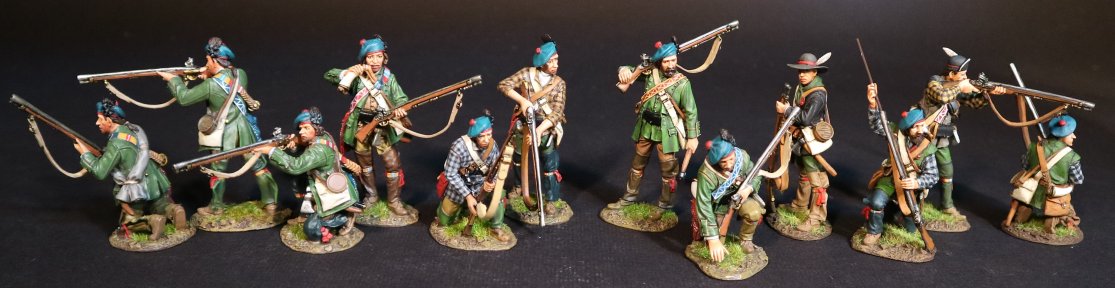
Roger’s Rangers was a company of soldiers form the Province of New Hampshire
raised by Major Robert Rogers and attached to the British Army during the Seven Year’s War (French and Indian War).
The unit was quickly adopted into the New England Colonies army as an independent ranger company. Rogers was inspired by colonial Frontiersman Ranger groups across North America and the teachings of unconventional warfare from Ranger such as Benjamin Church.
Robert Rogers trained and commanded his own rapidly deployable light infantry force , which was tasked mainly with reconnaissance as well as conducting special operations against distant targets.Their tactics were built on earlier Colonial precedents and were codified for the first time by Rogers as his 28 “Rules of Ranging”.
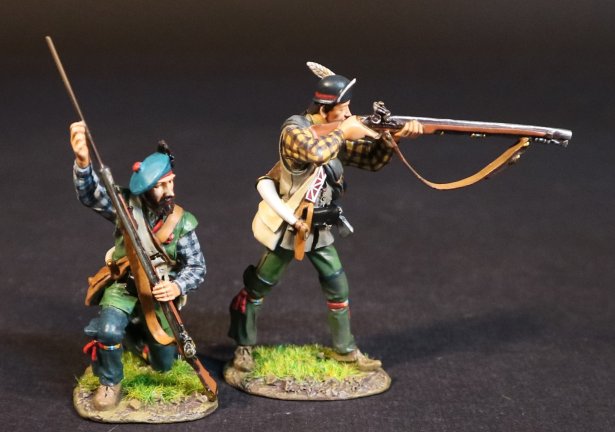
RR-36
THE EIGHTEENTH CENTURY COLLECTION
THE RAID ON ST. FRANCIS 1759,
ROGER’S RANGERS
The tactics proved remarkably effective, so much so that the initial company was expanded into a ranging corps of more than a dozen companies(containing as many as 1,200-1,400 men at its peak).The ranger corps became the chief scouting arm of British Crown forces by the late 1750s.The British forces in America valued Roger’s Rangers for their ability to gather intelligence about the enemy.They were disbanded in 1761.
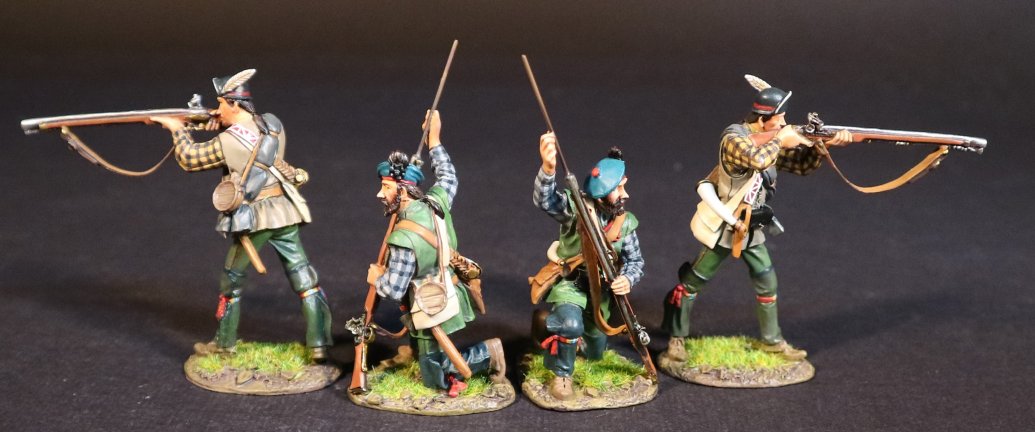
RR-36N
THE EIGHTEENTH CENTURY COLLECTION
THE RAID ON ST. FRANCIS 1759,
ROGER’S RANGERS
THE AMERICAN WAR OF INDEPENDENCE
AMERICAN ARTILLERY
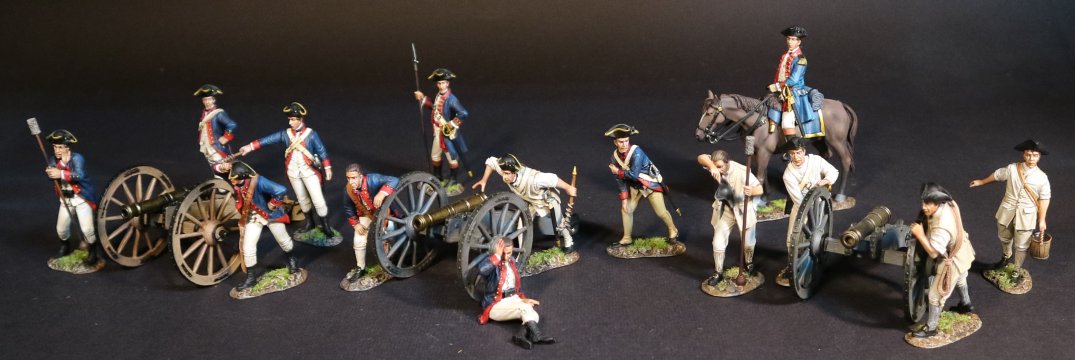
The Continental Army’s growing pains through the first years of the war caused Washington considerable irritation. Professional armies cannot be developed overnight, and the fits and starts of the Continental Army’s creation is illustrated most clearly in the establishment of the artillery. The United States had to build its artillery from scratch, but impressively by 1778 this branch of service was well regulated and effective.
Although the Continental Army’s artillery units were not affected by the uniform regulations as much as the infantry had been, there were still several different uniforms pre the 1778 regulations.
The change imposed on the artillery by the regulations was to make all four of the Continental regiments uniform in appearance as a branch of service and do away with distinctions between the regiments. This happened in October 1779.
Prior to this, the artillery arm of the Continental army had been noted as mainly wearing dark blue coats, usually faced red.
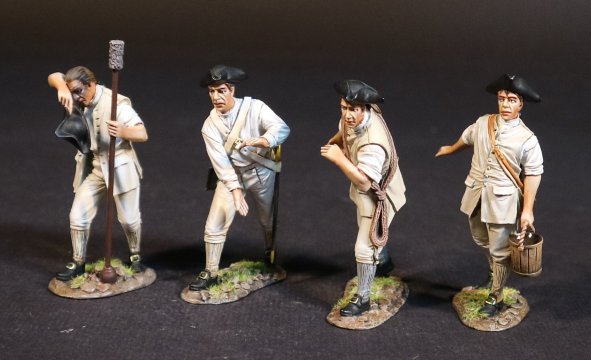
AWIART-06
THE AMERICAN WAR OF INDEPENDENCE 1775-1783,
THE AMERICAN ARTILLERY,
CONTINENTAL ARTILLERY
HAMILTON’S OWN
A company was authorized by the New York Provincial Congress, to be raised in July, 1775, by Captain John Lamb, for Continental service. It was ordered to the Northern Army, and served under General Montgomery before Quebec, where they did excellent service and suffered severely.
Their uniform for dress, when first organized, was a blue coat faced with buff, which was very unusual. Most of the artillery companies raised during the war wore blue faced with scarlet, which soon became the prescribed dress of that arm of the service in the American Army.
One other exception, was that of the second artillery company formed by order of the New York Provincial Congress, in January, 1776, and a few months later captained by Alexander Hamilton, whose commission was dated March 14, 1776. This second company, known as the Colony Artillery Company, was, like Captain Lamb's, uniformed on its in blue, faced with buff, but with blue waistcoats and leather breeches,
This New York Continental Artillery Company in 1776, was an elite unit of 60 men, led by Alexander Hamilton, who started his military career as an artillery officer. He was an independent minded commander who fought with courage and skill and later served as one of Washington’s aides de camp.
This new company would see action at the Battle of White Plains, and the Battle of Trenton. The New York Provincial Company of Artillery is considered the ancestor of the 1st Battalion, 5th Field Artillery Regiment, making it the oldest active unit in the US Regular Army.
Hamilton went on to become one of Founding Fathers of the United States before being killed by Aaron Burr in an 1804 duel. But his small artillery company would live on.
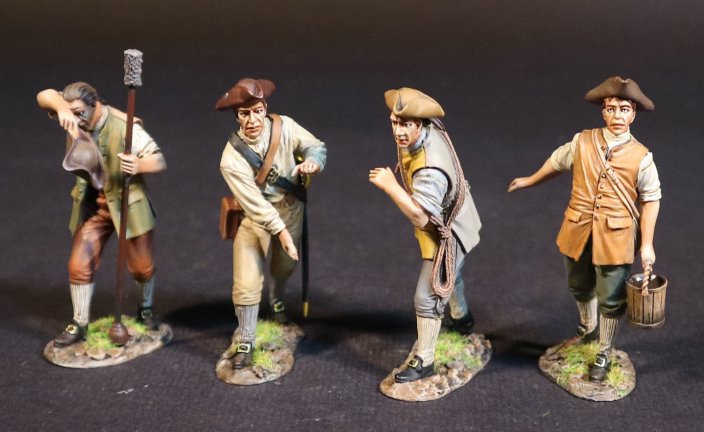
AWIART-06H
THE AMERICAN WAR OF INDEPENDENCE 1775-1783,
THE AMERICAN ARTILLERY,
THE NEW YORK CONTINENTAL ARTILLERY COMPANY,
“HAMILTON’S OWN”
On the battlefield itself, a crew of eight to ten cannoneers manned drag ropes and trail spikes to manoeuvre the guns into position, accomplished the intricate dance of loading gunpowder (mostly in bags of cloth or paper, but sometimes ladled loose down the barrel) and projectile down the muzzle of the piece, and set it in position to fire at the target. All artillery was muzzleloading and smooth-bore. Aiming was an art, accomplished by peering down the length of the tube and quickly making a rough calculation that combined distance to the target, weather conditions, quality of powder, and weight of projectile. Traverse was accomplished by manually shifting the entire carriage; changes in elevation were done by inserting a triangular wooden block, called a quoin, under the rear of the barrel. The piece had to be re-aimed after each shot, since there were no recoil mechanisms to return it to its original position after firing. The maximum effective range of artillery— even large-caliber guns firing solid shot—was about 1,200 yards (a mile and a half), and with untrained gunners using imperfect weapons and ammunition the range was about 400 yards. Because aiming was so imprecise, gunners invariably tried to minimize range before opening fire. Rates of fire varied with the pace of operations and, of course, the skill of the gun crew. The maximum rate of about eight rounds an hour could not be long sustained, both because of crew fatigue and overheating of the barrel.
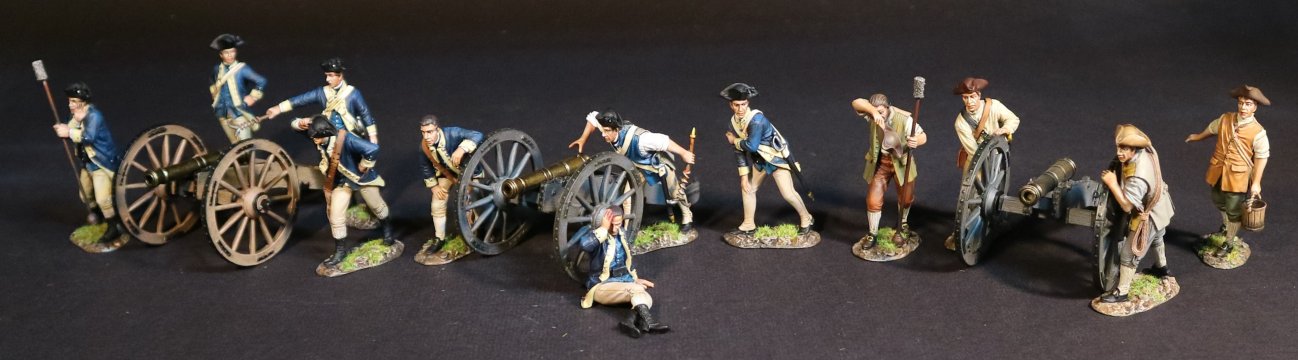
A matross was literally a gunner’s assistant and was the neophyte in the artillery enlisted hierarchy. As there was no American artillery school at this time, artillerymen were trained by their officers and NCO’s in the gun companies or “on the job” in combat
That the American artillery arm gained the high level of skill and reputation it did during the war is a testament to the dedication of the gunners that manned it.
SETTLERS AND REFUGEES
European settlers came to North America from a variety of social and religious groups, including adventurers, farmers, indentured servants, tradesmen, and a very few from the aristocracy.
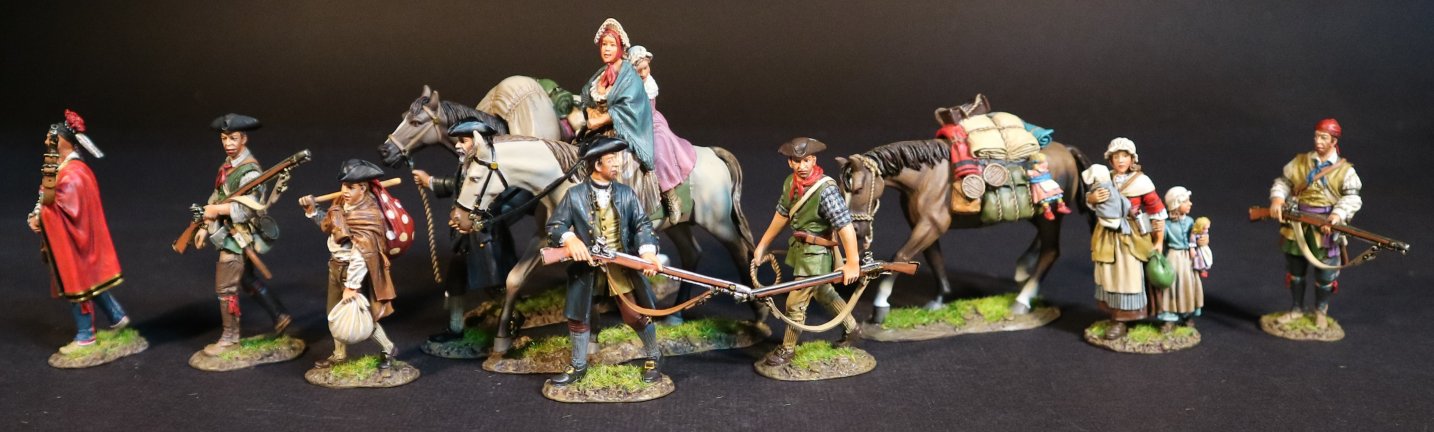
From the 1700’s settlements were mainly found along the coast, with only in the valley of the Hudson River had they penetrated inland more than a 100 miles.
Seventy years later settlements had spread inland 200 miles or more, to the crest of the Appalachians.
Before 1754 the westward expansion was slowed by the hostility of local tribes angered by the invasion of European settlers, and who were also incited by French and Spanish agents.
The French and Indian War began over the specific issue of whether the upper Ohio River walley was a part of the British Empire and therefore open for trade and settlement by Virginians and Pennsylvanians, or if it was part of the French Empire.
This war, fought by the British against the French for control of the territory for trade and settlement, was very expensive, which led to the post war British government implementing new taxes in the Thirteen Colonies.
The American Revolution was primarily caused by an erosion in the relationship between the British government and the Thirteen Colonies of America.
There were a number of reasons why this relationship broke down to the extent that it did, leading to a full scale war between the two sides.
In the aftermath of General Burgoyne’s defeat at Saratoga, many loyalists in the New York and Hampshire Grant regions chose to flee to the safety of Canada rather than face the prospects of poor treatment, forfeiture of property and imprisonment at the hands of the local revolutionaries.
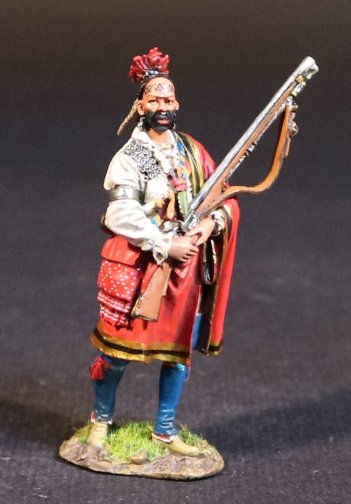
REF-04
THE EIGHTEENTH CENTURY COLLECTION,
SETTLERS AND REFUGEES,
MOHAWK GUIDE
Loyalist refugees traveled north to Canada, usually along two routes. New York loyalists typically followed an overland route through Native American territory to Lake Ontario. As most of the route was along forest trails, Indian guides were essential.
Unfortunately for many of the refugees, this included passage through territory held by the Oneidas, who were allies of the Americans. Continental and militia detachments that actively patrolled the region had also to be avoided.
Some loyalists might be lucky enough to make the trip in thirteen days, but most took much longer. An expedition of women and children that had to move slowly, would probably miss its boat connections, and with bad weather could take from two to three months to reach the Quebec province.
The King’s Royal Regiment of New York, or Johnson’s Royal Regiment of New York, was formed by exiled Loyalist leader, Sir John Johnson, from American refugees fleeing persecution.
The regiment served with distinction throughout the war, launching raids and relief missions into the Mohawk Valley of New York.
Each year the regiment sent parties on raids into the Mohawk and neighbouring valleys for the purposes of rescuing and escorting beleaguered Loyalists, and interfering with the ability of the Continental Army forces to use the region’s crops as a source of food for Washington’s army.
The British government controlling Canada was ill prepared for the arrival of thousands of men, women and children, who Governor Frederick Haldimand fittingly described as “loyalists in great distress”.
Incoming loyalists were questioned to determine what trade or profession they possessed and then were dispatched to specific locations to seek employment.
Others were assigned to refugee camps, where they were expected to work in exchange for aid.
The efforts of the British government to provide asylum for the loyalists were often in vain, and as the years progressed, existing difficulties were compounded with an ever greater influx of refugees.
**PLEASE CONTACT YOUR LOCAL DEALER TO PLACE YOUR PRE-ORDERS**
THE RAID ON ST. FRANCIS 1759
ROGER’S RANGERS
Roger’s Rangers was a company of soldiers form the Province of New Hampshire
raised by Major Robert Rogers and attached to the British Army during the Seven Year’s War (French and Indian War).
The unit was quickly adopted into the New England Colonies army as an independent ranger company. Rogers was inspired by colonial Frontiersman Ranger groups across North America and the teachings of unconventional warfare from Ranger such as Benjamin Church.
Robert Rogers trained and commanded his own rapidly deployable light infantry force , which was tasked mainly with reconnaissance as well as conducting special operations against distant targets.Their tactics were built on earlier Colonial precedents and were codified for the first time by Rogers as his 28 “Rules of Ranging”.
RR-36
THE EIGHTEENTH CENTURY COLLECTION
THE RAID ON ST. FRANCIS 1759,
ROGER’S RANGERS
The tactics proved remarkably effective, so much so that the initial company was expanded into a ranging corps of more than a dozen companies(containing as many as 1,200-1,400 men at its peak).The ranger corps became the chief scouting arm of British Crown forces by the late 1750s.The British forces in America valued Roger’s Rangers for their ability to gather intelligence about the enemy.They were disbanded in 1761.
RR-36N
THE EIGHTEENTH CENTURY COLLECTION
THE RAID ON ST. FRANCIS 1759,
ROGER’S RANGERS
THE AMERICAN WAR OF INDEPENDENCE
AMERICAN ARTILLERY
The Continental Army’s growing pains through the first years of the war caused Washington considerable irritation. Professional armies cannot be developed overnight, and the fits and starts of the Continental Army’s creation is illustrated most clearly in the establishment of the artillery. The United States had to build its artillery from scratch, but impressively by 1778 this branch of service was well regulated and effective.
Although the Continental Army’s artillery units were not affected by the uniform regulations as much as the infantry had been, there were still several different uniforms pre the 1778 regulations.
The change imposed on the artillery by the regulations was to make all four of the Continental regiments uniform in appearance as a branch of service and do away with distinctions between the regiments. This happened in October 1779.
Prior to this, the artillery arm of the Continental army had been noted as mainly wearing dark blue coats, usually faced red.
AWIART-06
THE AMERICAN WAR OF INDEPENDENCE 1775-1783,
THE AMERICAN ARTILLERY,
CONTINENTAL ARTILLERY
HAMILTON’S OWN
A company was authorized by the New York Provincial Congress, to be raised in July, 1775, by Captain John Lamb, for Continental service. It was ordered to the Northern Army, and served under General Montgomery before Quebec, where they did excellent service and suffered severely.
Their uniform for dress, when first organized, was a blue coat faced with buff, which was very unusual. Most of the artillery companies raised during the war wore blue faced with scarlet, which soon became the prescribed dress of that arm of the service in the American Army.
One other exception, was that of the second artillery company formed by order of the New York Provincial Congress, in January, 1776, and a few months later captained by Alexander Hamilton, whose commission was dated March 14, 1776. This second company, known as the Colony Artillery Company, was, like Captain Lamb's, uniformed on its in blue, faced with buff, but with blue waistcoats and leather breeches,
This New York Continental Artillery Company in 1776, was an elite unit of 60 men, led by Alexander Hamilton, who started his military career as an artillery officer. He was an independent minded commander who fought with courage and skill and later served as one of Washington’s aides de camp.
This new company would see action at the Battle of White Plains, and the Battle of Trenton. The New York Provincial Company of Artillery is considered the ancestor of the 1st Battalion, 5th Field Artillery Regiment, making it the oldest active unit in the US Regular Army.
Hamilton went on to become one of Founding Fathers of the United States before being killed by Aaron Burr in an 1804 duel. But his small artillery company would live on.
AWIART-06H
THE AMERICAN WAR OF INDEPENDENCE 1775-1783,
THE AMERICAN ARTILLERY,
THE NEW YORK CONTINENTAL ARTILLERY COMPANY,
“HAMILTON’S OWN”
On the battlefield itself, a crew of eight to ten cannoneers manned drag ropes and trail spikes to manoeuvre the guns into position, accomplished the intricate dance of loading gunpowder (mostly in bags of cloth or paper, but sometimes ladled loose down the barrel) and projectile down the muzzle of the piece, and set it in position to fire at the target. All artillery was muzzleloading and smooth-bore. Aiming was an art, accomplished by peering down the length of the tube and quickly making a rough calculation that combined distance to the target, weather conditions, quality of powder, and weight of projectile. Traverse was accomplished by manually shifting the entire carriage; changes in elevation were done by inserting a triangular wooden block, called a quoin, under the rear of the barrel. The piece had to be re-aimed after each shot, since there were no recoil mechanisms to return it to its original position after firing. The maximum effective range of artillery— even large-caliber guns firing solid shot—was about 1,200 yards (a mile and a half), and with untrained gunners using imperfect weapons and ammunition the range was about 400 yards. Because aiming was so imprecise, gunners invariably tried to minimize range before opening fire. Rates of fire varied with the pace of operations and, of course, the skill of the gun crew. The maximum rate of about eight rounds an hour could not be long sustained, both because of crew fatigue and overheating of the barrel.
A matross was literally a gunner’s assistant and was the neophyte in the artillery enlisted hierarchy. As there was no American artillery school at this time, artillerymen were trained by their officers and NCO’s in the gun companies or “on the job” in combat
That the American artillery arm gained the high level of skill and reputation it did during the war is a testament to the dedication of the gunners that manned it.
SETTLERS AND REFUGEES
European settlers came to North America from a variety of social and religious groups, including adventurers, farmers, indentured servants, tradesmen, and a very few from the aristocracy.
From the 1700’s settlements were mainly found along the coast, with only in the valley of the Hudson River had they penetrated inland more than a 100 miles.
Seventy years later settlements had spread inland 200 miles or more, to the crest of the Appalachians.
Before 1754 the westward expansion was slowed by the hostility of local tribes angered by the invasion of European settlers, and who were also incited by French and Spanish agents.
The French and Indian War began over the specific issue of whether the upper Ohio River walley was a part of the British Empire and therefore open for trade and settlement by Virginians and Pennsylvanians, or if it was part of the French Empire.
This war, fought by the British against the French for control of the territory for trade and settlement, was very expensive, which led to the post war British government implementing new taxes in the Thirteen Colonies.
The American Revolution was primarily caused by an erosion in the relationship between the British government and the Thirteen Colonies of America.
There were a number of reasons why this relationship broke down to the extent that it did, leading to a full scale war between the two sides.
In the aftermath of General Burgoyne’s defeat at Saratoga, many loyalists in the New York and Hampshire Grant regions chose to flee to the safety of Canada rather than face the prospects of poor treatment, forfeiture of property and imprisonment at the hands of the local revolutionaries.
REF-04
THE EIGHTEENTH CENTURY COLLECTION,
SETTLERS AND REFUGEES,
MOHAWK GUIDE
Loyalist refugees traveled north to Canada, usually along two routes. New York loyalists typically followed an overland route through Native American territory to Lake Ontario. As most of the route was along forest trails, Indian guides were essential.
Unfortunately for many of the refugees, this included passage through territory held by the Oneidas, who were allies of the Americans. Continental and militia detachments that actively patrolled the region had also to be avoided.
Some loyalists might be lucky enough to make the trip in thirteen days, but most took much longer. An expedition of women and children that had to move slowly, would probably miss its boat connections, and with bad weather could take from two to three months to reach the Quebec province.
The King’s Royal Regiment of New York, or Johnson’s Royal Regiment of New York, was formed by exiled Loyalist leader, Sir John Johnson, from American refugees fleeing persecution.
The regiment served with distinction throughout the war, launching raids and relief missions into the Mohawk Valley of New York.
Each year the regiment sent parties on raids into the Mohawk and neighbouring valleys for the purposes of rescuing and escorting beleaguered Loyalists, and interfering with the ability of the Continental Army forces to use the region’s crops as a source of food for Washington’s army.
The British government controlling Canada was ill prepared for the arrival of thousands of men, women and children, who Governor Frederick Haldimand fittingly described as “loyalists in great distress”.
Incoming loyalists were questioned to determine what trade or profession they possessed and then were dispatched to specific locations to seek employment.
Others were assigned to refugee camps, where they were expected to work in exchange for aid.
The efforts of the British government to provide asylum for the loyalists were often in vain, and as the years progressed, existing difficulties were compounded with an ever greater influx of refugees.
**PLEASE CONTACT YOUR LOCAL DEALER TO PLACE YOUR PRE-ORDERS**


