


- Joined
- Feb 2, 2011
- Messages
- 2,485
NEW RELEASES FOR APRIL 2026
THE SECOND WORLD WAR
GERMAN ARMOUR
On 1 September 1939, the world witnessed the shocking debut of a new form of warfare when Germany invaded Poland: Blitzkrieg, or “lightning war.” This revolutionary doctrine of combined arms warfare utilized Panzer divisions with massed tank formations, motorized infantry, artillery, and close air support operations operating together, allowing the German Wehrmacht to strike with unprecedented speed and precision. Each Panzer platoon operated with remarkable coordination, exploiting breakthroughs and maintaining contact with supporting infantry and Stuka dive-bombers, and showcased the devastating synergy that defined Blitzkrieg. This new German doctrine rapidly overwhelmed and surrounded Polish forces, leading to the surrender of Poland in little more than a month of combat operations. The rapidity of German victory truly stunned the world, even more so when Blitzkrieg’s success was repeated over the next two years of WW2 in the invasions of Yugoslavia and Greece, during the Fall of France, and in the invasion of Russia during Operation Barbarossa. These early victories led to the belief in the invincibility of Blitzkrieg, and it would take tremendous combat losses and years of warfare for the Allies to shatter the myth of the invincibility of Germany’s Panzertruppe.
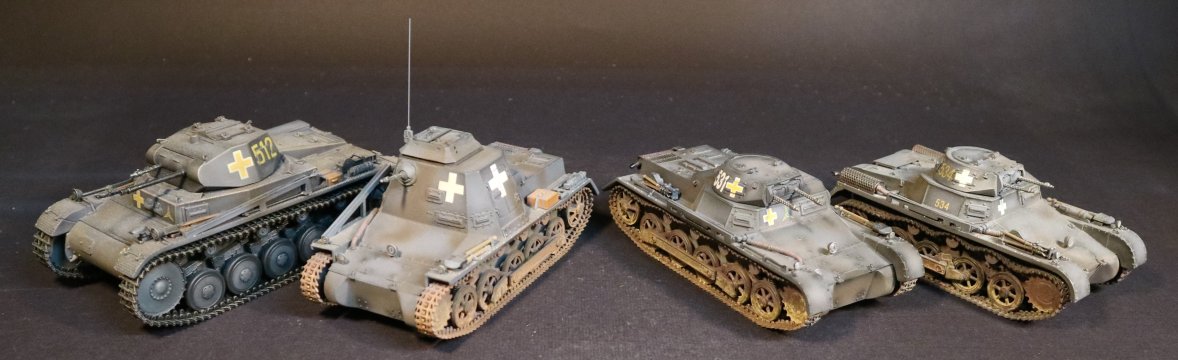
Originally designed as a training tank to get around the Treaty of Versailles and provide both German industry and the burgeoning Panzertruppe with experience in producing and employing armor on a mass scale, the Panzer I was envisioned as an interim solution until the Panzer II, Panzer III, and Panzer IV were produced in large numbers. Due to Hitler’s eager ambitions for conquest, in 1939 the Panzer I still constituted the majority of armored vehicles available to the Panzer Divisions when the Wehrmacht was unleashed across the Polish frontier.
GA-11B
THE SECOND WORLD WAR,
GERMAN ARMOUR,
Panzer I Ausf. B #531,
4. Panzer-Division, Heeresgruppe Nord,
Poland, September 1939
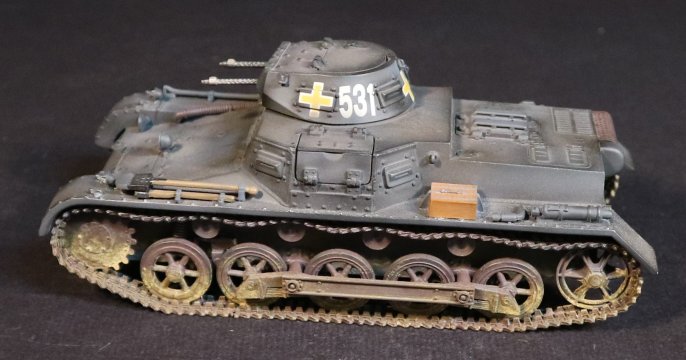
The Panzer I Ausf. B was a follow-on design to the Panzer I Ausf. A and addressed some of its predecessor’s shortcomings by incorporating a more powerful engine. This redesign required a slightly lengthened hull and an additional road wheel. The Ausf. B offered improved performance and endurance, but its thin armor left it proof against only small arms. Consequently, the Panzer I Ausf. B was vulnerable to any Polish anti-tank weapon, anti-tank rifles, and even heavy machine guns. Additionally, its armament of tin 7.92 mm MG-15 machineguns were only effective against infantry, cavalry, or light vehicles. Despite these deficiencies, when employed en masse and in close coordination with Stuka dive-bombers providing close air support, the Panzer I proved itself capable of overwhelming enemy units. It was this close cooperation of combined arms units, including massed panzers, that led to the success of Germany’s new armored doctrine, and not because of any technical superiority of early-war German tanks.
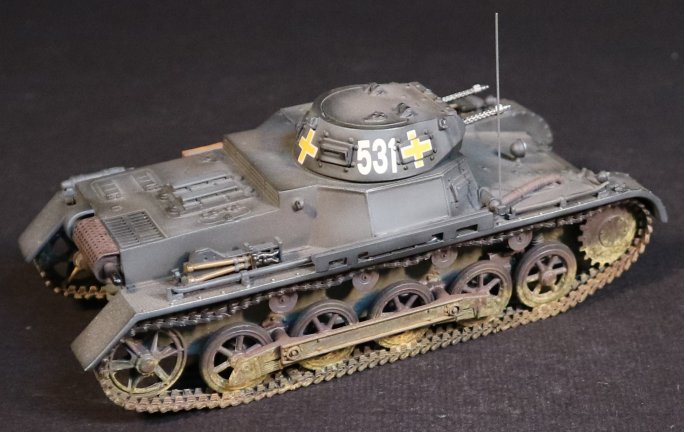
John Jenkins Designs Panzer I Ausf. B #531 represents an early production Panzer I Ausf. B of the famous 35. Panzer Regiment of 4. Panzer-Division (4. Pz.Div.). As part of the XVI. Armeekorps, 4. Pz.Div. was one of the first divisions of Heeresgruppe Süd (Army Group South) to cross the Polish border. It fought against Polish cavalry at the Battle of Mokra and was the first German unit to reach Warsaw. It suffered heavy casualties in its initial direct assault to take the city and in subsequent attempts to take the city, fighting alongside the Leibstandarte SS Adolf Hitler Regiment. Later it fought in the Battle of the Bzura (Battle of Kutno), the largest battle of the Polish campaign.
Part of the iconic look of German panzers during the Polish campaign were the multiple large, white Balkenkreuz that adorned German panzers to serve as a national recognition feature. Just days into combat operations, the Germans realized these white crosses served as excellent aiming points for enemy gunners. Consequently, the panzer crews rapidly toned down the visibility of their Balkenkreuz either with mud or by overpainting them in yellow, sometimes with a small white border still showing, as seen on Panzer I #531. This look is how Panzer II #512 displays the 4. Pz.Div. insignia on the front hull.
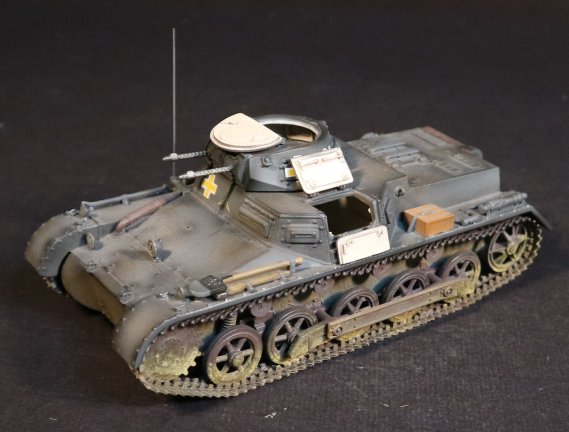
JJ Designs announces the newest releases in the Panzer I series. Either used as a standalone piece or combined with the previously released JJD Polish Panzer I and Panzer II from the same division, Panzer I #531 works perfectly for collectors’ vignettes or dioramas depicting the 1939 Polish campaign.
As standard for all JJ D tank models, Panzer II #512 comes with the following features:
The success of Germany’s new armored warfare doctrine, named Blitzkrieg or “Lightning War” by the Allies (although this term was not used by the Germans), was not due to any inherent technical superiority of German panzers. Instead, Germany’s success in armored warfare was due to the excellent training, flexibility, and superior command and control of its forces, coupled with new combined arms tactics and doctrine that yielded synergistic effects by employing infantry, armor, artillery, and aircraft in close coordination. This combined arms approach was a new innovation by the Germans and in stark contrast to the Allies, who still employed their infantry, armor, and artillery forces as separate units that at best operated in poor coordination on the battlefield. On the other hand, a Panzer Division in 1939 was a self-contained combined arms force under a single commander consisting of tanks from two Panzer regiments, infantry from two regiments with engineer support from an additional Panzerpioniere Bataillon, and an artillery battalion. Additionally, a Luftwaffe ground liaison was usually incorporated within the Panzer Division to coordinate close air support from Stuka bomber squadrons. This new organization and superior command and control was the true secret to the success of Blitzkrieg.
GA-16P
THE SECOND WORLD WAR,
GERMAN ARMOUR,
kleiner Panzerbefehlswagen (Sd.Kfz. 265),
4. Panzer-Division, Heeresgruppe Nord,
Poland, September 1939
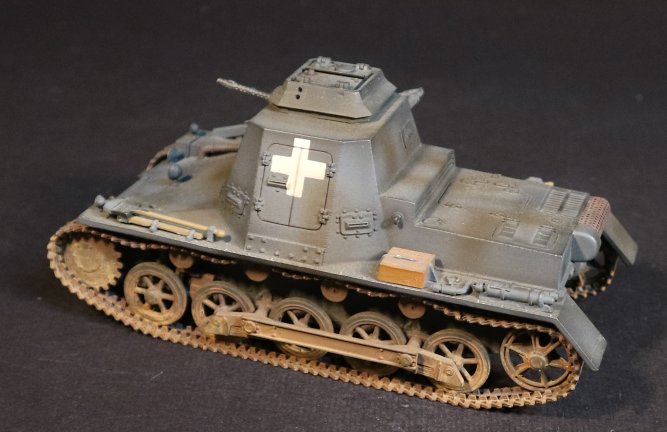
Also unlike Allied tank units in 1939, every German Panzer was equipped with a radio. Consequently, a vital link in the command and control capabilities of the Panzer divisions was the Sd.Kfz. 265 kleiner Panzerbefehlswagen (small armored command vehicle). Based on the Panzer I Ausf. B chassis, the kleiner Panzerbefehlswagen replaced the panzer’s turret with a larger armored superstructure and was equipped with a 20-watt transmitter and a Fu 6 multiple radio receiver, which provided radio coverage of 4–6 km. This provided an unparalleled capability to employ massed armored units while maintaining real-time communication between the regiment, battalion, company, and platoon levels. Consequently, German Panzer units could react much faster to unfolding combat situations than their Allied counterparts, executing cohesive platoon, company, and even regimental maneuvers that overwhelmed their opponents. Additionally, the kleiner Panzerbefehlswagen was also equipped with an MG-34 machine gun in a superstructure ball mount to provide close protection.
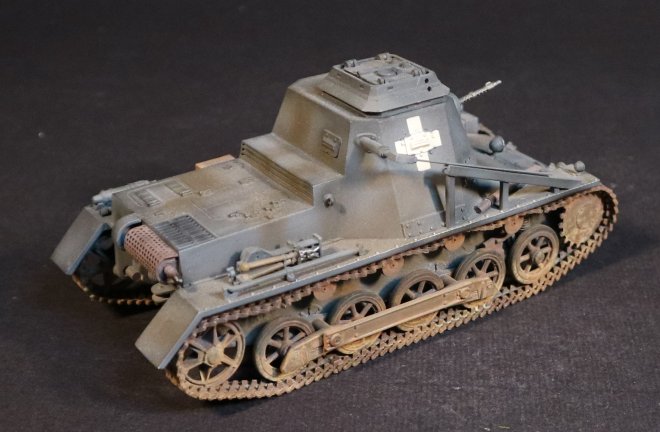
John Jenkins Designs kleiner Panzerbefehlswagen represents a command panzer of the famous 35. Panzer Regiment of 4. Panzer-Division (4. Pz.Div.). As part of the XVI. Armeekorps, 4. Pz.Div. was one of the first divisions of Heeresgruppe Süd (Army Group South) to cross the Polish border. It fought against Polish cavalry at the Battle of Mokra and was the first German unit to reach Warsaw. It suffered heavy casualties in its initial direct assault to take the city and in subsequent attempts to take the city, fighting alongside the Leibstandarte SS Adolf Hitler Regiment. Later it fought in the Battle of the Bzura (Battle of Kutno), the largest battle of the Polish campaign.
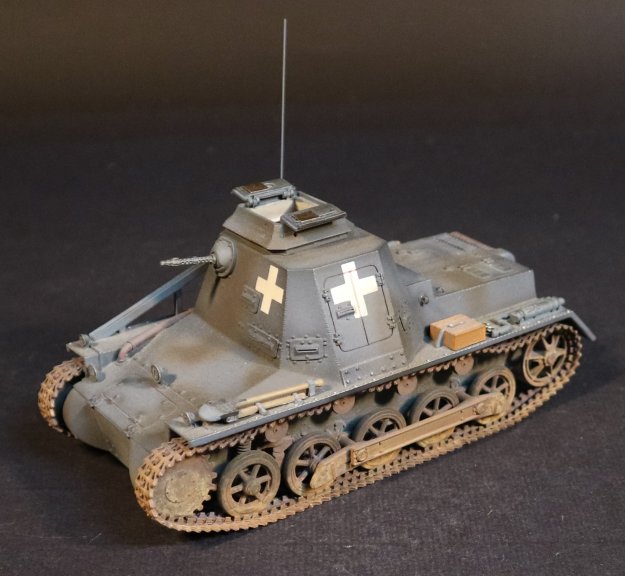
JJ Designs announces the kleiner Panzerbefehlswagen, which features the large white Balkenkreuz that served as the national symbol of Germany and were the iconic look of Germany’s Panzer force as it was unleashed upon the world. Either used as a standalone piece or combined with the previously released JJD Polish Panzer I and Panzer II from the same division, the JJD kleiner Panzerbefehlswagen works perfectly for collectors’ vignettes or dioramas depicting the 1939 Polish campaign.
As standard for all John Jenkins Designs tank models, the kleiner Panzerbefehlswagen comes with the following features:
**PLEASE CONTACT YOUR LOCAL DEALER TO PLACE YOUR PRE-ORDERS**
THE SECOND WORLD WAR
GERMAN ARMOUR
On 1 September 1939, the world witnessed the shocking debut of a new form of warfare when Germany invaded Poland: Blitzkrieg, or “lightning war.” This revolutionary doctrine of combined arms warfare utilized Panzer divisions with massed tank formations, motorized infantry, artillery, and close air support operations operating together, allowing the German Wehrmacht to strike with unprecedented speed and precision. Each Panzer platoon operated with remarkable coordination, exploiting breakthroughs and maintaining contact with supporting infantry and Stuka dive-bombers, and showcased the devastating synergy that defined Blitzkrieg. This new German doctrine rapidly overwhelmed and surrounded Polish forces, leading to the surrender of Poland in little more than a month of combat operations. The rapidity of German victory truly stunned the world, even more so when Blitzkrieg’s success was repeated over the next two years of WW2 in the invasions of Yugoslavia and Greece, during the Fall of France, and in the invasion of Russia during Operation Barbarossa. These early victories led to the belief in the invincibility of Blitzkrieg, and it would take tremendous combat losses and years of warfare for the Allies to shatter the myth of the invincibility of Germany’s Panzertruppe.
Originally designed as a training tank to get around the Treaty of Versailles and provide both German industry and the burgeoning Panzertruppe with experience in producing and employing armor on a mass scale, the Panzer I was envisioned as an interim solution until the Panzer II, Panzer III, and Panzer IV were produced in large numbers. Due to Hitler’s eager ambitions for conquest, in 1939 the Panzer I still constituted the majority of armored vehicles available to the Panzer Divisions when the Wehrmacht was unleashed across the Polish frontier.
GA-11B
THE SECOND WORLD WAR,
GERMAN ARMOUR,
Panzer I Ausf. B #531,
4. Panzer-Division, Heeresgruppe Nord,
Poland, September 1939
The Panzer I Ausf. B was a follow-on design to the Panzer I Ausf. A and addressed some of its predecessor’s shortcomings by incorporating a more powerful engine. This redesign required a slightly lengthened hull and an additional road wheel. The Ausf. B offered improved performance and endurance, but its thin armor left it proof against only small arms. Consequently, the Panzer I Ausf. B was vulnerable to any Polish anti-tank weapon, anti-tank rifles, and even heavy machine guns. Additionally, its armament of tin 7.92 mm MG-15 machineguns were only effective against infantry, cavalry, or light vehicles. Despite these deficiencies, when employed en masse and in close coordination with Stuka dive-bombers providing close air support, the Panzer I proved itself capable of overwhelming enemy units. It was this close cooperation of combined arms units, including massed panzers, that led to the success of Germany’s new armored doctrine, and not because of any technical superiority of early-war German tanks.
John Jenkins Designs Panzer I Ausf. B #531 represents an early production Panzer I Ausf. B of the famous 35. Panzer Regiment of 4. Panzer-Division (4. Pz.Div.). As part of the XVI. Armeekorps, 4. Pz.Div. was one of the first divisions of Heeresgruppe Süd (Army Group South) to cross the Polish border. It fought against Polish cavalry at the Battle of Mokra and was the first German unit to reach Warsaw. It suffered heavy casualties in its initial direct assault to take the city and in subsequent attempts to take the city, fighting alongside the Leibstandarte SS Adolf Hitler Regiment. Later it fought in the Battle of the Bzura (Battle of Kutno), the largest battle of the Polish campaign.
Part of the iconic look of German panzers during the Polish campaign were the multiple large, white Balkenkreuz that adorned German panzers to serve as a national recognition feature. Just days into combat operations, the Germans realized these white crosses served as excellent aiming points for enemy gunners. Consequently, the panzer crews rapidly toned down the visibility of their Balkenkreuz either with mud or by overpainting them in yellow, sometimes with a small white border still showing, as seen on Panzer I #531. This look is how Panzer II #512 displays the 4. Pz.Div. insignia on the front hull.
JJ Designs announces the newest releases in the Panzer I series. Either used as a standalone piece or combined with the previously released JJD Polish Panzer I and Panzer II from the same division, Panzer I #531 works perfectly for collectors’ vignettes or dioramas depicting the 1939 Polish campaign.
As standard for all JJ D tank models, Panzer II #512 comes with the following features:
- Rotating turret with opening hatches
- Historically accurate early-war paint job and markings
- Detailed crew and fighting compartments
The success of Germany’s new armored warfare doctrine, named Blitzkrieg or “Lightning War” by the Allies (although this term was not used by the Germans), was not due to any inherent technical superiority of German panzers. Instead, Germany’s success in armored warfare was due to the excellent training, flexibility, and superior command and control of its forces, coupled with new combined arms tactics and doctrine that yielded synergistic effects by employing infantry, armor, artillery, and aircraft in close coordination. This combined arms approach was a new innovation by the Germans and in stark contrast to the Allies, who still employed their infantry, armor, and artillery forces as separate units that at best operated in poor coordination on the battlefield. On the other hand, a Panzer Division in 1939 was a self-contained combined arms force under a single commander consisting of tanks from two Panzer regiments, infantry from two regiments with engineer support from an additional Panzerpioniere Bataillon, and an artillery battalion. Additionally, a Luftwaffe ground liaison was usually incorporated within the Panzer Division to coordinate close air support from Stuka bomber squadrons. This new organization and superior command and control was the true secret to the success of Blitzkrieg.
GA-16P
THE SECOND WORLD WAR,
GERMAN ARMOUR,
kleiner Panzerbefehlswagen (Sd.Kfz. 265),
4. Panzer-Division, Heeresgruppe Nord,
Poland, September 1939
Also unlike Allied tank units in 1939, every German Panzer was equipped with a radio. Consequently, a vital link in the command and control capabilities of the Panzer divisions was the Sd.Kfz. 265 kleiner Panzerbefehlswagen (small armored command vehicle). Based on the Panzer I Ausf. B chassis, the kleiner Panzerbefehlswagen replaced the panzer’s turret with a larger armored superstructure and was equipped with a 20-watt transmitter and a Fu 6 multiple radio receiver, which provided radio coverage of 4–6 km. This provided an unparalleled capability to employ massed armored units while maintaining real-time communication between the regiment, battalion, company, and platoon levels. Consequently, German Panzer units could react much faster to unfolding combat situations than their Allied counterparts, executing cohesive platoon, company, and even regimental maneuvers that overwhelmed their opponents. Additionally, the kleiner Panzerbefehlswagen was also equipped with an MG-34 machine gun in a superstructure ball mount to provide close protection.
John Jenkins Designs kleiner Panzerbefehlswagen represents a command panzer of the famous 35. Panzer Regiment of 4. Panzer-Division (4. Pz.Div.). As part of the XVI. Armeekorps, 4. Pz.Div. was one of the first divisions of Heeresgruppe Süd (Army Group South) to cross the Polish border. It fought against Polish cavalry at the Battle of Mokra and was the first German unit to reach Warsaw. It suffered heavy casualties in its initial direct assault to take the city and in subsequent attempts to take the city, fighting alongside the Leibstandarte SS Adolf Hitler Regiment. Later it fought in the Battle of the Bzura (Battle of Kutno), the largest battle of the Polish campaign.
JJ Designs announces the kleiner Panzerbefehlswagen, which features the large white Balkenkreuz that served as the national symbol of Germany and were the iconic look of Germany’s Panzer force as it was unleashed upon the world. Either used as a standalone piece or combined with the previously released JJD Polish Panzer I and Panzer II from the same division, the JJD kleiner Panzerbefehlswagen works perfectly for collectors’ vignettes or dioramas depicting the 1939 Polish campaign.
As standard for all John Jenkins Designs tank models, the kleiner Panzerbefehlswagen comes with the following features:
- Opening commander’s hatch
- Antenna can be raised or lowered
- Historically accurate paint job and markings
- Detailed crew compartment
**PLEASE CONTACT YOUR LOCAL DEALER TO PLACE YOUR PRE-ORDERS**