


- Joined
- Feb 2, 2011
- Messages
- 2,489
THE JACOBITE REBELLION 1745
CUMBERLAND’S ARMY
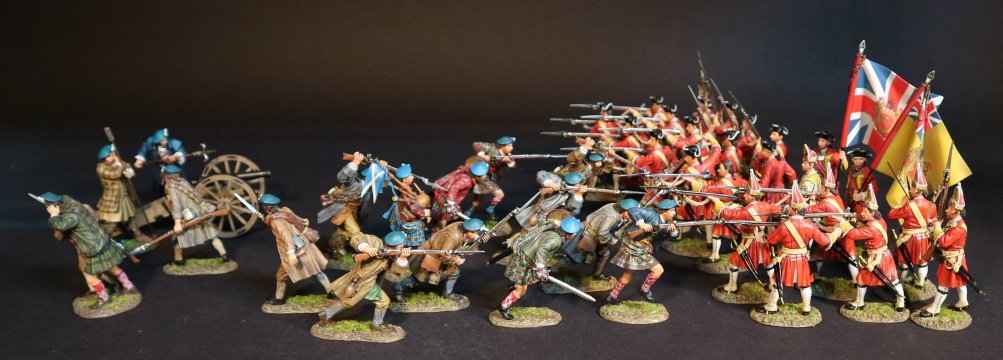
The Jacobite rising of 1745 was an attempt by Charles Edward Stuart to regain the British throne for his father.
It took place during the War of The Austrian Succession, when the bulk of the British Army was fighting in mainland Europe. It proved to be the last in a series of revolts that began in 1689, with other major outbreaks in 1715 and 1719.
Charles launched the rebellion on 19th August 1745 at Glenfinnan in the Scottish Highlands, capturing Edinburgh and winning the Battle of Prestonpans in September.
At a council in October the Scots agreed to invade England after Charles assured them of substantial support from English Jacobites and a simultaneous French landing in Southern England.
Neither of these assurances were to take place or to materialise, therefore the decision to retreat back to Scotland took place, leading to the defeat at Culloden in April, which ended the rebellion.
Charles was to escape to France, but was unable to win further support for another attempt, and died in Rome in 1788.
The Battle of Culloden on 16th April 1745 which is often cited as the last pitched battle on British soil
Lasted less than an hour and ended in a decisive government victory.
Exhausted by a night march carried out in a failed atrtempt to surprise Cumberland’s troops, many Jacobites missed the battle, leaving fewer than 5,000 to face a well rested and equipped force of 7,000 to 9,000.
Fighting began with an artillery exchange, with the government army vastly superior in training and co-ordination. James Grant an officer in the Irish Brigade who served as the head of the Jacobite artillery, was absent, having been wounded at the Siege of Fort William, this obviously contributed to the government artillery totally dominating the exchange.
Charles held his position, expecting Cumberland to attack, but he refused to do so and unable to respond to the artillery fire, Charles ordered his front line to charge.
As the Jacobite army advanced, the boggy ground in front of them forced the centre of the army to move over to the right, where they became entangled with the left wing regiments of the government army.
As the government artillery switched to grapeshot, it inflicted heavy casualties. Despite these heavy casualties the highlanders crashed into the Cumberland’s left, which gave ground but did not break.
Unable to break the government lines, the highlanders broke and fell back in confusion.
The North eastern regiments, Irish and Scots regulars in the second line retired in good order, allowing Charles and his personal retinue to escape.
Troops that held together, like the French regulars, were far less vulnerable in retreat, but many Highlanders were cut down in the pursuit. Government casualties are estimated as 50 killed, plus 259 wounded; many Jacobite wounded remaining on the battlefield were reportedly killed afterwards, their losses being 1,200 to 1,500 dead and 500 prisoners.
Several thousand armed Jacobites remained at large, and over the next two days, an estimated 1,500 assembled at Ruthven Barracks.
On 20 April, Charles ordered them to disperse, arguing French assistance was required to continue the fight and they should return home until he returned with additional support.
DEJEAN’S REGIMENT OF FOOT
The British army at this time consisted of 69 red coated regular infantry regiments. Each was organized as a single battalion, which comprised of ten companies, which included one company of grenadiers. Each company had an ideal strength of 70 rank and file, so a battalion had 700 men.
As was often the case maintaining companies at full strength especially at war time was difficult.
At Culloden the strongest infantry battalion was in fact Dejean’s Regiment, which mustered 426 men. Blakeney’s 27th had just 300.
Only the grenadier company in each regiment was maintained at something like its proper strength, by constantly milking the other battalion companies of their most experienced soldiers.
The 37th regiment was raised in Ireland by Lieutenant-General Thomas Meredyth as Meredyth's Regiment in February 1702
The regiment next saw action at the Battle of Dettingen in June 1743 during the War of the Austrian Succession.
It also fought at the Battle of Falkirk in January 1746 during the Jacobite Rebellion when its Colonel, Sir Robert Munro, 6th Baronet, was shot and then finished off with three sword blows to the head.
It went on to fight under the command of Colonel Lewis Dejean at the Battle of Culloden in April 1746.
The regiment returned to the Netherlands and fought at the Battle of Lauffeld in July 1747.
On 1st July 1751 a royal warrant was issued which provided that in future regiments would no longer be known by their colonel’s name, but would bear a regimental number based on their precedence.
Dejean’s Regiment became the 37th Regiment of Foot.

BJ37-19
THE JACOBITE REBELLION 1745,
THE BATTLE OF CULLODEN, 16th APRIL 1745,
CUMBERLAND’S ARMY,
DEJEAN’S REGIMENT OF FOOT,
LINE INFANTRY “PUSH BAYONET”
There are a number of eyewitness accounts of the actions of the British army at Culloden, written by British officers, and two of the accounts were written by members of Dejean’s Regiment.
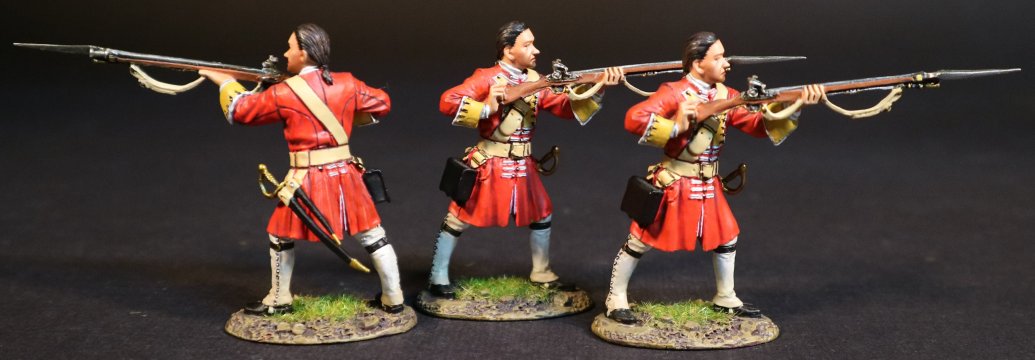
BJ37-19N
THE JACOBITE REBELLION 1745,
THE BATTLE OF CULLODEN, 16th APRIL 1745,
CUMBERLAND’S ARMY,
DEJEAN’S REGIMENT OF FOOT,
LINE INFANTRY “PUSH BAYONETS”
A grenadier officer mentions how his platoon was almost overrun, and makes an important comment that the men of his regiment were disinclined to take prisoners that day because it was firmly believed that a number of their officers had been murdered in cold blood by the rebels at the Battle of Falkirk, three months earlier.
Another account describes how the front rank men stood fast with charged bayonets, protecting the two ranks behind while they carried on loading and firing.
It is believed and widely reported that the innovation and instruction for each man to thrust at the Highlander approaching to his right rather than the one coming directly at him, which bypassed the highlanders targe or defensive shield, was a contributing factor to defeating the Jacobite highlander.
This drill is well illustrated in David Morier’s celebrated painting “Incident In The Rebellion”, and shows the front rank of Barrel’s 4th Foot charging their bayonets.
Dejean’s Regiment were positioned next to Barrell’s 4th Foot, who were overrun by the Highland assault, although Dejean’s Regiment held their ground they also were to suffer heavy casualties at the battle.
It was reported that 14 killed and 68 wounded, these losses were only second to the badly mauled 4th Foot.
THE JACOBITE ARMY
The Jacobite rising of 1745 was an attempt by Charles Edward Stuart to regain the British throne for his father.
It took place during the War of The Austrian Succession, when the bulk of the British Army was fighting in mainland Europe. It proved to be the last in a series of revolts that began in 1689, with other major outbreaks in 1715 and 1719.
Charles launched the rebellion on 19th August 1745 at Glenfinnan in the Scottish Highlands, capturing Edinburgh and winning the Battle of Prestonpans in September.
At a council in October the Scots agreed to invade England after Charles assured them of substantial support from English Jacobites and a simultaneous French landing in Southern England.
Neither of these assurances were to take place or to materialise, therefore the decision to retreat back to Scotland took place, leading to the defeat at Culloden in April, which ended the rebellion.
Charles was to escape to France, but was unable to win further support for another attempt, and died in Rome in 1788.
The Battle of Culloden on 16th April 1745 which is often cited as the last pitched battle on British soil
Lasted less than an hour and ended in a decisive government victory.
Exhausted by a night march carried out in a failed attempt to surprise Cumberland’s troops, many Jacobites missed the battle, leaving fewer than 5,000 to face a well rested and equipped force of 7,000 to 9,000.
Fighting began with an artillery exchange, with the government army vastly superior in training and co-ordination. James Grant an officer in the Irish Brigade who served as the head of the Jacobite artillery, was absent, having been wounded at the Siege of Fort William, this obviously contributed to the government artillery totally dominating the exchange.
Charles held his position, expecting Cumberland to attack, but he refused to do so and unable to respond to the artillery fire, Charles ordered his front line to charge.
As the Jacobite army advanced, the boggy ground in front of them forced the centre of the army to move over to the right, where they became entangled with the left wing regiments of the government army.
As the government artillery switched to grapeshot, it inflicted heavy casualties. Despite these heavy casualties the highlanders crashed into the Cumberland’s left, which gave ground but did not break.
Unable to break the government lines, the highlanders broke and fell back in confusion.
The North eastern regiments, Irish and Scots regulars in the second line retired in good order, allowing Charles and his personal retinue to escape.
Troops that held together, like the French regulars, were far less vulnerable in retreat, but many Highlanders were cut down in the pursuit. Government casualties are estimated as 50 killed, plus 259 wounded; many Jacobite wounded remaining on the battlefield were reportedly killed afterwards, their losses being 1,200 to 1,500 dead and 500 prisoners.
Several thousand armed Jacobites remained at large, and over the next two days, an estimated 1,500 assembled at Ruthven Barracks.
On 20 April, Charles ordered them to disperse, arguing French assistance was required to continue the fight and they should return home until he returned with additional support.
The Jacobite army also included a large number of north-eastern and lowland Scots, along with substantial Franco-Irish and English contingents, who were drilled and organized in line with contemporary European military practices.
The Jacobite infantry was initially divided into two divisions, “Highland” and “low Country Foot”
Following British army customs they were split into regiments usually of one battalion. Each battalion had a nominal strength of 200-300 men, although actual numbers were often much smaller.
The regiments of Lochiel, Glengarry and Ogilvy also had grenadier companies, although how these were distinguished is not known.
Highland regiments were traditionally organized by clan, and were officered by their own clansmen. This made some regiments impractically small and efforts were made to amalgamate clans to produce larger units. The units would keep their original captains and leaders which led to the Jacobite army having too many officers.
While the Lowland recruits were more successful in adapting an European style of training, the Highland military traditions were unsuitable to European army tactics.
Professional soldiers required constant training in firing and reloading, in which the Jacobites lacked time, weapons and ammunition. It is recorded that a simplified but effective form of drill was introduced for them.
Most Jacobite professionals had been trained in France, and infantry drill and tactics showed a French influence. This included movement in narrow columns, deployment of reserves in column, and firing in volleys by fire “a billebaude” (at will) as opposed to the rigid firing by platoon used by the British army.
The French emphasis on shock tactics, rather than massed firepower, suited the abilities and training levels of Jacobite troops.
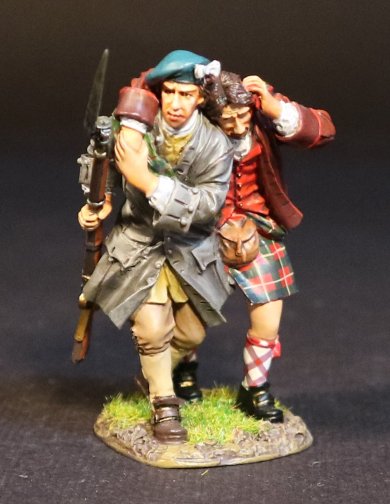
JR-38A
THE JACOBITE REBELLION 1745,
THE BATTLE OF CULLODEN, 16th APRIL 1745,
THE JACOBITE ARMY,
JACOBITE WOUNDED FLEEING
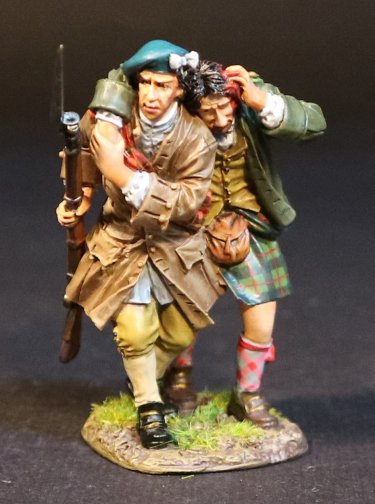
JR-38B
THE JACOBITE REBELLION 1745,
THE BATTLE OF CULLODEN, 16th APRIL 1745,
THE JACOBITE ARMY,
JACOBITE WOUNDED FLEEING
Please Contact your Dealer to pre-order!
CUMBERLAND’S ARMY
The Jacobite rising of 1745 was an attempt by Charles Edward Stuart to regain the British throne for his father.
It took place during the War of The Austrian Succession, when the bulk of the British Army was fighting in mainland Europe. It proved to be the last in a series of revolts that began in 1689, with other major outbreaks in 1715 and 1719.
Charles launched the rebellion on 19th August 1745 at Glenfinnan in the Scottish Highlands, capturing Edinburgh and winning the Battle of Prestonpans in September.
At a council in October the Scots agreed to invade England after Charles assured them of substantial support from English Jacobites and a simultaneous French landing in Southern England.
Neither of these assurances were to take place or to materialise, therefore the decision to retreat back to Scotland took place, leading to the defeat at Culloden in April, which ended the rebellion.
Charles was to escape to France, but was unable to win further support for another attempt, and died in Rome in 1788.
The Battle of Culloden on 16th April 1745 which is often cited as the last pitched battle on British soil
Lasted less than an hour and ended in a decisive government victory.
Exhausted by a night march carried out in a failed atrtempt to surprise Cumberland’s troops, many Jacobites missed the battle, leaving fewer than 5,000 to face a well rested and equipped force of 7,000 to 9,000.
Fighting began with an artillery exchange, with the government army vastly superior in training and co-ordination. James Grant an officer in the Irish Brigade who served as the head of the Jacobite artillery, was absent, having been wounded at the Siege of Fort William, this obviously contributed to the government artillery totally dominating the exchange.
Charles held his position, expecting Cumberland to attack, but he refused to do so and unable to respond to the artillery fire, Charles ordered his front line to charge.
As the Jacobite army advanced, the boggy ground in front of them forced the centre of the army to move over to the right, where they became entangled with the left wing regiments of the government army.
As the government artillery switched to grapeshot, it inflicted heavy casualties. Despite these heavy casualties the highlanders crashed into the Cumberland’s left, which gave ground but did not break.
Unable to break the government lines, the highlanders broke and fell back in confusion.
The North eastern regiments, Irish and Scots regulars in the second line retired in good order, allowing Charles and his personal retinue to escape.
Troops that held together, like the French regulars, were far less vulnerable in retreat, but many Highlanders were cut down in the pursuit. Government casualties are estimated as 50 killed, plus 259 wounded; many Jacobite wounded remaining on the battlefield were reportedly killed afterwards, their losses being 1,200 to 1,500 dead and 500 prisoners.
Several thousand armed Jacobites remained at large, and over the next two days, an estimated 1,500 assembled at Ruthven Barracks.
On 20 April, Charles ordered them to disperse, arguing French assistance was required to continue the fight and they should return home until he returned with additional support.
DEJEAN’S REGIMENT OF FOOT
The British army at this time consisted of 69 red coated regular infantry regiments. Each was organized as a single battalion, which comprised of ten companies, which included one company of grenadiers. Each company had an ideal strength of 70 rank and file, so a battalion had 700 men.
As was often the case maintaining companies at full strength especially at war time was difficult.
At Culloden the strongest infantry battalion was in fact Dejean’s Regiment, which mustered 426 men. Blakeney’s 27th had just 300.
Only the grenadier company in each regiment was maintained at something like its proper strength, by constantly milking the other battalion companies of their most experienced soldiers.
The 37th regiment was raised in Ireland by Lieutenant-General Thomas Meredyth as Meredyth's Regiment in February 1702
The regiment next saw action at the Battle of Dettingen in June 1743 during the War of the Austrian Succession.
It also fought at the Battle of Falkirk in January 1746 during the Jacobite Rebellion when its Colonel, Sir Robert Munro, 6th Baronet, was shot and then finished off with three sword blows to the head.
It went on to fight under the command of Colonel Lewis Dejean at the Battle of Culloden in April 1746.
The regiment returned to the Netherlands and fought at the Battle of Lauffeld in July 1747.
On 1st July 1751 a royal warrant was issued which provided that in future regiments would no longer be known by their colonel’s name, but would bear a regimental number based on their precedence.
Dejean’s Regiment became the 37th Regiment of Foot.
BJ37-19
THE JACOBITE REBELLION 1745,
THE BATTLE OF CULLODEN, 16th APRIL 1745,
CUMBERLAND’S ARMY,
DEJEAN’S REGIMENT OF FOOT,
LINE INFANTRY “PUSH BAYONET”
There are a number of eyewitness accounts of the actions of the British army at Culloden, written by British officers, and two of the accounts were written by members of Dejean’s Regiment.
BJ37-19N
THE JACOBITE REBELLION 1745,
THE BATTLE OF CULLODEN, 16th APRIL 1745,
CUMBERLAND’S ARMY,
DEJEAN’S REGIMENT OF FOOT,
LINE INFANTRY “PUSH BAYONETS”
A grenadier officer mentions how his platoon was almost overrun, and makes an important comment that the men of his regiment were disinclined to take prisoners that day because it was firmly believed that a number of their officers had been murdered in cold blood by the rebels at the Battle of Falkirk, three months earlier.
Another account describes how the front rank men stood fast with charged bayonets, protecting the two ranks behind while they carried on loading and firing.
It is believed and widely reported that the innovation and instruction for each man to thrust at the Highlander approaching to his right rather than the one coming directly at him, which bypassed the highlanders targe or defensive shield, was a contributing factor to defeating the Jacobite highlander.
This drill is well illustrated in David Morier’s celebrated painting “Incident In The Rebellion”, and shows the front rank of Barrel’s 4th Foot charging their bayonets.
Dejean’s Regiment were positioned next to Barrell’s 4th Foot, who were overrun by the Highland assault, although Dejean’s Regiment held their ground they also were to suffer heavy casualties at the battle.
It was reported that 14 killed and 68 wounded, these losses were only second to the badly mauled 4th Foot.
THE JACOBITE ARMY
The Jacobite rising of 1745 was an attempt by Charles Edward Stuart to regain the British throne for his father.
It took place during the War of The Austrian Succession, when the bulk of the British Army was fighting in mainland Europe. It proved to be the last in a series of revolts that began in 1689, with other major outbreaks in 1715 and 1719.
Charles launched the rebellion on 19th August 1745 at Glenfinnan in the Scottish Highlands, capturing Edinburgh and winning the Battle of Prestonpans in September.
At a council in October the Scots agreed to invade England after Charles assured them of substantial support from English Jacobites and a simultaneous French landing in Southern England.
Neither of these assurances were to take place or to materialise, therefore the decision to retreat back to Scotland took place, leading to the defeat at Culloden in April, which ended the rebellion.
Charles was to escape to France, but was unable to win further support for another attempt, and died in Rome in 1788.
The Battle of Culloden on 16th April 1745 which is often cited as the last pitched battle on British soil
Lasted less than an hour and ended in a decisive government victory.
Exhausted by a night march carried out in a failed attempt to surprise Cumberland’s troops, many Jacobites missed the battle, leaving fewer than 5,000 to face a well rested and equipped force of 7,000 to 9,000.
Fighting began with an artillery exchange, with the government army vastly superior in training and co-ordination. James Grant an officer in the Irish Brigade who served as the head of the Jacobite artillery, was absent, having been wounded at the Siege of Fort William, this obviously contributed to the government artillery totally dominating the exchange.
Charles held his position, expecting Cumberland to attack, but he refused to do so and unable to respond to the artillery fire, Charles ordered his front line to charge.
As the Jacobite army advanced, the boggy ground in front of them forced the centre of the army to move over to the right, where they became entangled with the left wing regiments of the government army.
As the government artillery switched to grapeshot, it inflicted heavy casualties. Despite these heavy casualties the highlanders crashed into the Cumberland’s left, which gave ground but did not break.
Unable to break the government lines, the highlanders broke and fell back in confusion.
The North eastern regiments, Irish and Scots regulars in the second line retired in good order, allowing Charles and his personal retinue to escape.
Troops that held together, like the French regulars, were far less vulnerable in retreat, but many Highlanders were cut down in the pursuit. Government casualties are estimated as 50 killed, plus 259 wounded; many Jacobite wounded remaining on the battlefield were reportedly killed afterwards, their losses being 1,200 to 1,500 dead and 500 prisoners.
Several thousand armed Jacobites remained at large, and over the next two days, an estimated 1,500 assembled at Ruthven Barracks.
On 20 April, Charles ordered them to disperse, arguing French assistance was required to continue the fight and they should return home until he returned with additional support.
The Jacobite army also included a large number of north-eastern and lowland Scots, along with substantial Franco-Irish and English contingents, who were drilled and organized in line with contemporary European military practices.
The Jacobite infantry was initially divided into two divisions, “Highland” and “low Country Foot”
Following British army customs they were split into regiments usually of one battalion. Each battalion had a nominal strength of 200-300 men, although actual numbers were often much smaller.
The regiments of Lochiel, Glengarry and Ogilvy also had grenadier companies, although how these were distinguished is not known.
Highland regiments were traditionally organized by clan, and were officered by their own clansmen. This made some regiments impractically small and efforts were made to amalgamate clans to produce larger units. The units would keep their original captains and leaders which led to the Jacobite army having too many officers.
While the Lowland recruits were more successful in adapting an European style of training, the Highland military traditions were unsuitable to European army tactics.
Professional soldiers required constant training in firing and reloading, in which the Jacobites lacked time, weapons and ammunition. It is recorded that a simplified but effective form of drill was introduced for them.
Most Jacobite professionals had been trained in France, and infantry drill and tactics showed a French influence. This included movement in narrow columns, deployment of reserves in column, and firing in volleys by fire “a billebaude” (at will) as opposed to the rigid firing by platoon used by the British army.
The French emphasis on shock tactics, rather than massed firepower, suited the abilities and training levels of Jacobite troops.
JR-38A
THE JACOBITE REBELLION 1745,
THE BATTLE OF CULLODEN, 16th APRIL 1745,
THE JACOBITE ARMY,
JACOBITE WOUNDED FLEEING
JR-38B
THE JACOBITE REBELLION 1745,
THE BATTLE OF CULLODEN, 16th APRIL 1745,
THE JACOBITE ARMY,
JACOBITE WOUNDED FLEEING
Please Contact your Dealer to pre-order!


