

- Joined
- Feb 2, 2011
- Messages
- 2,428
NEW RELEASES FOR MARCH 2026
THE ANGLO ZULU WAR
THE BATTLE OF GINGINDHLOVU, 2nd APRIL 1879.
The Battle of Gingindhlovu was fought on 2nd April 1879 between a British relief column sent to break the siege at Eshowe, and a Zulu impi of king Cetshwayo.
The British soldier would refer to it as the Battle of “GIN GIN I LOVE YOU”.
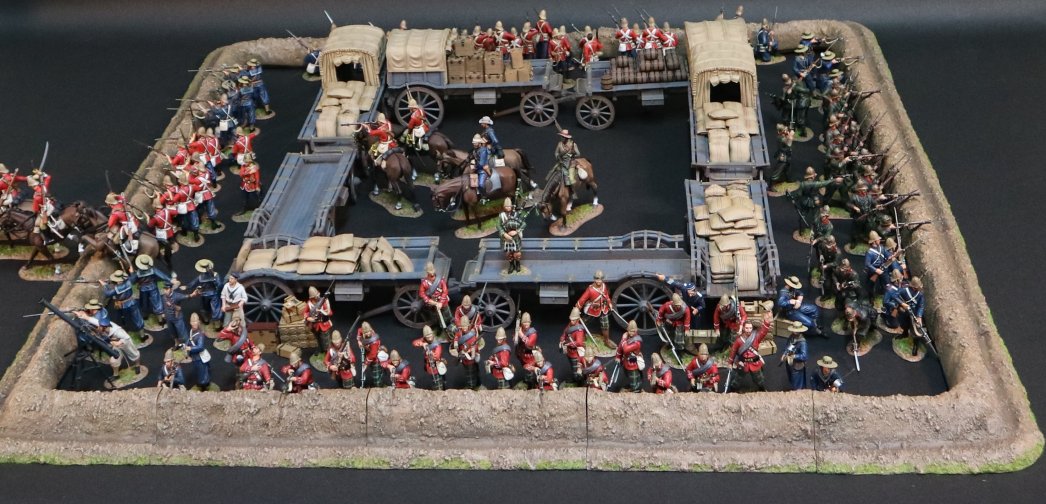
Charles Pearson had led No.1 column of the British invasion force across the Tugela River to establish an advanced base at Eshowe. Having set up a base at a deserted Norwegian mission station, the British found themselves besieged.
A relief column was organized by Lord Chelmsford and departed Fort Tenedos on 29th March to relieve the garrison.
Chelmsford’s relief force comprised 3,390 Europeans, and 2,280 Africans.
Lord Chelmsford ensured his men spent much time laagering and entrenching their camp at the end of each day, and kept ammunition boxes open and at the ready.
Although this was slow progress, Pearson’s observers at Eshowe were able to see the relief column entrenched on the south bank of the Neyzane, on the evening of the 1st April.
The Zulu impi was composed of 12,000 warriors, some of whom were Isandlwana veterans drawn from regiments in the main Zulu army, while the remainder were warriors who lived in the vicinity of Eshowe.
Many of the Zulu commanders wanted to attack the relief column that night, but Prince Dabulamanzi KaMpande, who was half brother to king Cetshwayo and commander of the impi’s right wing, convinced them to wait until morning.
At dawn on 2 April 1879, the morning sun revealed muddy ground and a heavy mist. Chelmsford had decided after hearing Dunn's report to not continue on toward Eshowe early the next morning. Instead, he would deploy units of the Natal Native Contingent to feel for the Zulus. As the NNC were preparing to advance shots were heard from the night pickets still on duty. The impi was advancing; the main force split into two columns before crossing the Ineyzane and assuming the "chest and horns" formation. The left horn sharply curved to the right to assault the laager's north-east corner, while the "chest" gently curved toward the north face of the laager.
Another force passed Misi Hill and approached the laager, forming the impi’s right horn.
The buffalo formation came in at a run on the three sides of the laager as Chelmsford had wanted; at a range of 300–400 yd (270–370 m) the British infantry opened fire, supported by the Gatling guns and rockets.
Zulu marksmen caused a few casualties within the laager, but the defenders kept the Zulus at bay.
Although the Zulu regiments made persistent rushes to get within stabbing range, their charges lacked the drive and spirit that had pushed them forward at Isandlwana and Rorke’s Drift.
The only zulu to reach the laager was a ten year old boy, who was immediately taken prisoner by members of the naval brigade and later served as a kind of mascot on their ship, Boadicea.
Around 7am, the main impi attack had been halted. Chelmsford ordered his mounted troops to attack, followed by the NNC.
Many zulu were killed as they withdrew.
Chelmsford had begun to avenge the Imperial dead of Isandlwana, but for the present he was content to relieve Pearson and return to Natal.
THE 99th (DUKE OF EDINBURGH’S) REGIMENT
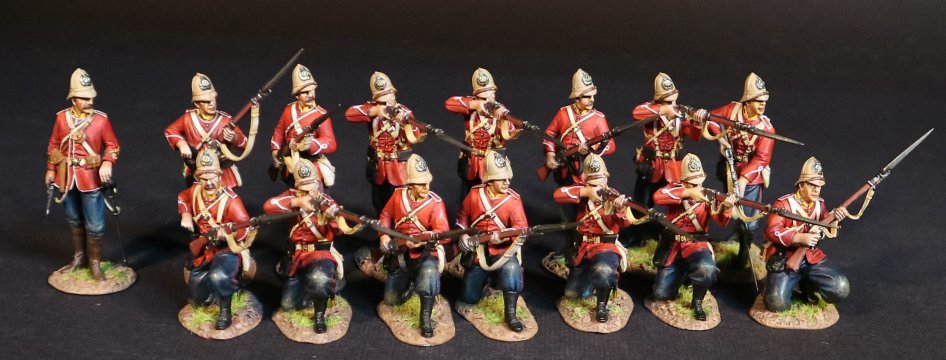
The 99th were stationed at Chatham when, at the end of November 1878 they received orders to embark for South Africa. During the first invasion of Zululand they were attached to Colonel Pearson’s No.1 Column.
The headquarters and three companies of the Regiment were at Eshowe during the investment until relieved on 3rd April by Lord Chelmsford’s column, which included five companies of the 99th.
The five companies of the 99th Regiment were part of the 1st Brigade of the Eshowe relief column, and defended part of the west face of the laager alongside the two companies of the 2nd Battalion, 3rd Regiment.
During the second invasion, the regiment was attached to the 1st Brigade of Crealock’s 1st Division along with the Buffs and the Connaught Rangers.
The regiment’s principal occupation until the middle of June was convoy duty.
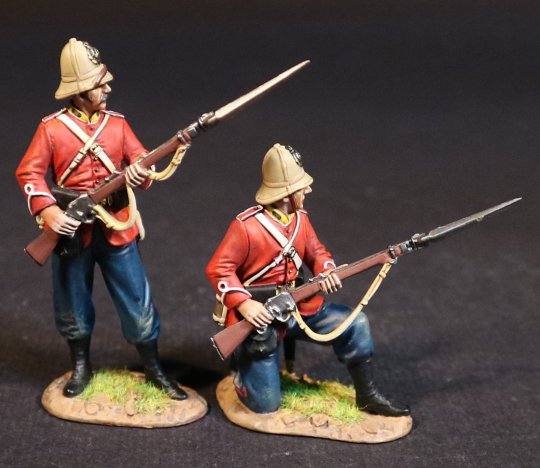
GG99-04
THE ANGLO ZULU WAR
THE BATTLE OF GINGINDHLOVU, 2nd APRIL 1879,
THE ESHOWE RELIEF COLUMN,
THE 99th (DUKE OF EDINBURGH’S) REGIMENT
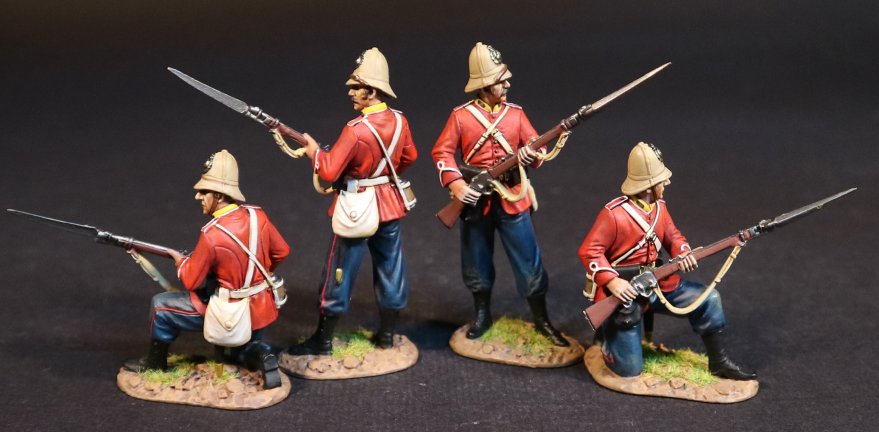
GG99-04N
THE ANGLO ZULU WAR
THE BATTLE OF GINGINDHLOVU, 2nd APRIL 1879,
THE ESHOWE RELIEF COLUMN,
THE 99th (DUKE OF EDINBURGH’S) REGIMENT
THE ROYAL MARINE LIGHT INFANTRY
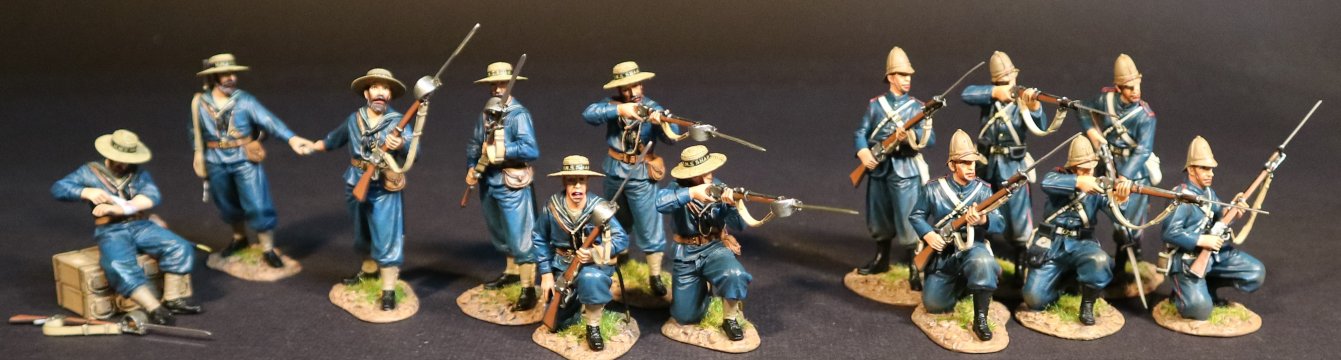
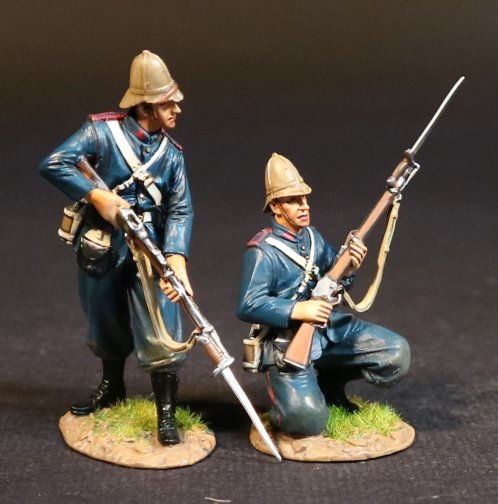
GGM-03
THE ANGLO ZULU WAR
THE BATTLE OF GINGINDHLOVU, 2nd APRIL 1879,
THE ESHOWE RELIEF COLUMN,
ROYAL MARINE LIGHT INFANTRY
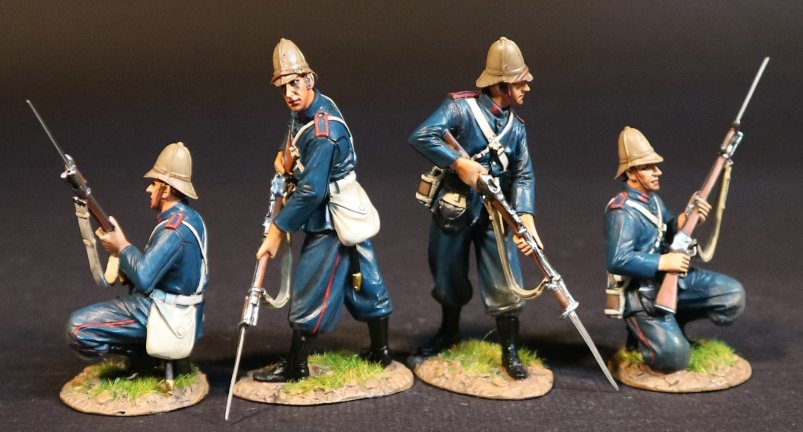
GGM-03N
THE ANGLO ZULU WAR
THE BATTLE OF GINGINDHLOVU, 2nd APRIL 1879,
THE ESHOWE RELIEF COLUMN,
ROYAL MARINE LIGHT INFANTRY
On 20th March HMS Boadicea also landed a brigade of 10 officers and 218 men.
About 100 Royal Marines were also included.
Two Brigades were formed for the relief column for Eshowe. The artillery for this force came entirely from the Naval Brigades. The allocation was as follows
1st Brigade, included two 9pdrs, two 24pdr Rocket Tubes, and one Gatling gun.
2nd Brigade, included two 24pdr Rocket Tubes and one Gatling Gun.
The 9pdrs, Rockets and Gatlings were positioned at the corners of the British enclosure. The Gatling Guns opened fire at 1,000m, and as the Zulus approached they were engaged by all the artillery weapons.
Naval attachments brought with them their own artillery, including Gatlings which were both used to good effect at Gingindhlovu.
The Naval Brigade Gatlings were apparently mounted on different carriages to their army counterparts, these being narrower and minus the axle-tree boxes.
There were also a number of Hale’s rockets. These were the heavy 24pdrs, fired from tubes rather than the army’s troughs. These tubes were originally designed to be bracketed onto the side of a ship, but by 1879 a modified version replaced the bracket with a tripod for land service, and it was this “Fisher” tube which was the type used in Zululand.
The navy also landed some of its field guns. At Gingindhlovu the naval Brigade had two 9-pounder guns.
A drawing of the relief column, shows the Naval Brigade with a 9pdr which does not appear to be of the standard Army pattern. At this time there was a great deal of experiments carried out on artillery pieces, and it is possible that the Navy were given some of these “experimental” guns for their landing parties. It was a time of change in Britain’s artillery.
Since no plans or other drawings exist of these experimental guns, I have decided to produce the standard Royal Artillery 9 pdr.
MOUNTED INFANTRY
At the beginning of the campaign Chelmsford had no regular cavalry regiments at his disposal, which was a setback given the cavalry traditional role of scouting and pursuit.
He did however have two understrength squadrons of Mounted Infantry, who were distributed throughout the invading columns.
The Mounted Infantry consisted of selected soldiers from infantry regiments mounted on locally acquired horses.
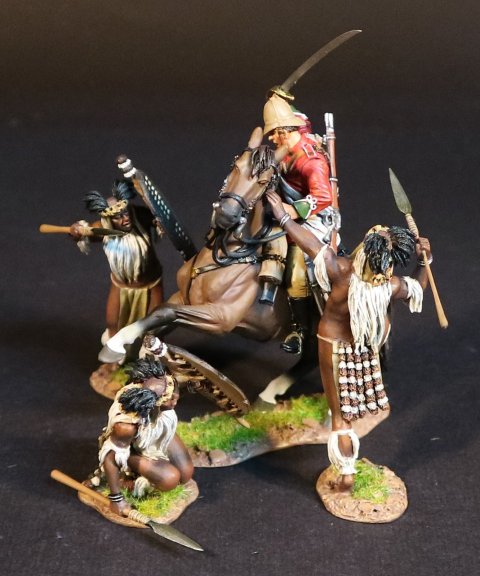
During the Zulu war the men of the mounted infantry, chosen from nearly every infantry battalion, wore their regiment’s tunic, cord breeches and riding boots.
They were armed with Martini-Henry rifles, and instead of the usual infantry equipment carried a bandolier.
Despite the mixed origins of this Mounted Infantry force, it performed extremely well, and paved the way for greater reliance on Mounted Infantry units in later campaigns.
Major P. H. S. Barrow was to command the 70 Mounted Infantry at Gingindhlovu, and had armed the men with sabres.
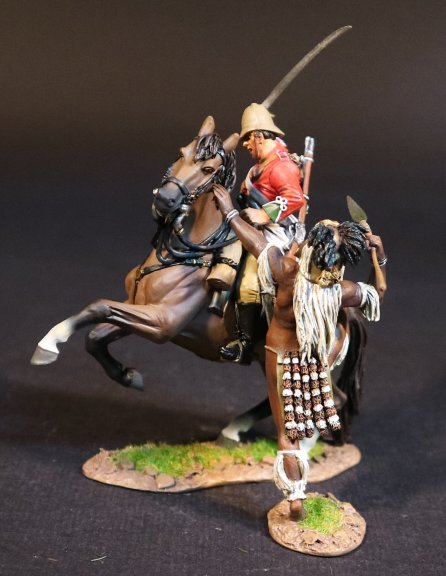
GGMI-10
THE ANGLO ZULU WAR
THE BATTLE OF GINGINDHLOVU, 2nd APRIL 1879,
THE ESHOWE RELIEF COLUMN,
MOUNTED INFANTRY AND ZULU WARRIOR
THE ZULU IMPI
The Zulu impi was composed of 12,000 warriors, some of whom were Isandlwana veterans drawn from regiments in the main Zulu army, while the remainder were warriors who lived in the vicinity of Eshowe.
Many of the Zulu commanders wanted to attack the relief column that night, but Prince Dabulamanzi KaMpande, who was half brother to king Cetshwayo and commander of the impi’s right wing, convinced them to wait until morning.
At dawn on 2 April 1879, the morning sun revealed muddy ground and a heavy mist. Chelmsford had decided after hearing Dunn's report to not continue on toward Eshowe early the next morning. Instead, he would deploy units of the Natal Native Contingent to feel for the Zulus. As the NNC were preparing to advance shots were heard from the night pickets still on duty. The impi was advancing; the main force split into two columns before crossing the Ineyzane and assuming the "chest and horns" formation. The left horn sharply curved to the right to assault the laager's north-east corner, while the "chest" gently curved toward the north face of the laager.
The robust and vigorous Zulu clansman was the result of his upbringing, his entire boyhood being spent on the veldt tending cattle. This outdoor existence not only toughened his body and gave him great endurance but also gave him extensive knowledge of the terrain of his homeland.
By 1879 the Zulu army consisted of 33 regiments.
These regiments were more than just military units, they were an integral part of the Zulu social system and once formed could only be broken by death, for there was no retirement or buying out in the Zulu army and men in their 60’s and 70’s as long as they were physically able to take the field, answered the King’s call to arms.
THE umCijo REGIMENT
The umCijo Zulu regiment was formed in 1867, and was known as “The Sharp Pointed”, and as uKhandempemvu “The White Headed”, probably because of the white cow tails in their head dress.
If the Zulu had had regimental colours like their British foes, then this young regiment would have carried one well marked with battle honours.
At Isandlwana the umCijo impi literally spear headed the attack on the camp, occupying the centre and moving forward on their stomachs under a hail of bullets till the defenders’ ammunition began to run out. The units in front of them were Natal Natives who broke and fled when the umCijo rose to their feet and charged. Although badly shot up, the umCijo wiped out the rear ranks of A and F companies.
Two months later, under the leadership of Mnyamana, they fell on the north side of the Kambula laager and suffered many casualties.
The umCijo this time led by Zibhebhu refused to allow the royal cattle to be sent to Chelmsford as a peace offering, and at Ulundi they were the first in the ill fated assault on the British square.
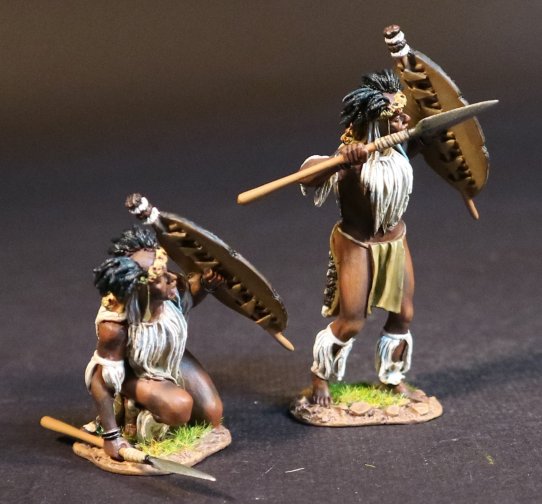
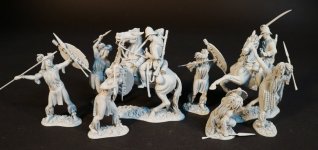
GGZ-10
THE ANGLO ZULU WAR
THE BATTLE OF GINGINDHLOVU, 2nd APRIL 1879,
THE ZULU IMPI.
THE umCijo REGIMENT,
ZULU WARRIORS
Please Contact your Dealer to pre-order!
THE ANGLO ZULU WAR
THE BATTLE OF GINGINDHLOVU, 2nd APRIL 1879.
The Battle of Gingindhlovu was fought on 2nd April 1879 between a British relief column sent to break the siege at Eshowe, and a Zulu impi of king Cetshwayo.
The British soldier would refer to it as the Battle of “GIN GIN I LOVE YOU”.
Charles Pearson had led No.1 column of the British invasion force across the Tugela River to establish an advanced base at Eshowe. Having set up a base at a deserted Norwegian mission station, the British found themselves besieged.
A relief column was organized by Lord Chelmsford and departed Fort Tenedos on 29th March to relieve the garrison.
Chelmsford’s relief force comprised 3,390 Europeans, and 2,280 Africans.
Lord Chelmsford ensured his men spent much time laagering and entrenching their camp at the end of each day, and kept ammunition boxes open and at the ready.
Although this was slow progress, Pearson’s observers at Eshowe were able to see the relief column entrenched on the south bank of the Neyzane, on the evening of the 1st April.
The Zulu impi was composed of 12,000 warriors, some of whom were Isandlwana veterans drawn from regiments in the main Zulu army, while the remainder were warriors who lived in the vicinity of Eshowe.
Many of the Zulu commanders wanted to attack the relief column that night, but Prince Dabulamanzi KaMpande, who was half brother to king Cetshwayo and commander of the impi’s right wing, convinced them to wait until morning.
At dawn on 2 April 1879, the morning sun revealed muddy ground and a heavy mist. Chelmsford had decided after hearing Dunn's report to not continue on toward Eshowe early the next morning. Instead, he would deploy units of the Natal Native Contingent to feel for the Zulus. As the NNC were preparing to advance shots were heard from the night pickets still on duty. The impi was advancing; the main force split into two columns before crossing the Ineyzane and assuming the "chest and horns" formation. The left horn sharply curved to the right to assault the laager's north-east corner, while the "chest" gently curved toward the north face of the laager.
Another force passed Misi Hill and approached the laager, forming the impi’s right horn.
The buffalo formation came in at a run on the three sides of the laager as Chelmsford had wanted; at a range of 300–400 yd (270–370 m) the British infantry opened fire, supported by the Gatling guns and rockets.
Zulu marksmen caused a few casualties within the laager, but the defenders kept the Zulus at bay.
Although the Zulu regiments made persistent rushes to get within stabbing range, their charges lacked the drive and spirit that had pushed them forward at Isandlwana and Rorke’s Drift.
The only zulu to reach the laager was a ten year old boy, who was immediately taken prisoner by members of the naval brigade and later served as a kind of mascot on their ship, Boadicea.
Around 7am, the main impi attack had been halted. Chelmsford ordered his mounted troops to attack, followed by the NNC.
Many zulu were killed as they withdrew.
Chelmsford had begun to avenge the Imperial dead of Isandlwana, but for the present he was content to relieve Pearson and return to Natal.
THE 99th (DUKE OF EDINBURGH’S) REGIMENT
The 99th were stationed at Chatham when, at the end of November 1878 they received orders to embark for South Africa. During the first invasion of Zululand they were attached to Colonel Pearson’s No.1 Column.
The headquarters and three companies of the Regiment were at Eshowe during the investment until relieved on 3rd April by Lord Chelmsford’s column, which included five companies of the 99th.
The five companies of the 99th Regiment were part of the 1st Brigade of the Eshowe relief column, and defended part of the west face of the laager alongside the two companies of the 2nd Battalion, 3rd Regiment.
During the second invasion, the regiment was attached to the 1st Brigade of Crealock’s 1st Division along with the Buffs and the Connaught Rangers.
The regiment’s principal occupation until the middle of June was convoy duty.
GG99-04
THE ANGLO ZULU WAR
THE BATTLE OF GINGINDHLOVU, 2nd APRIL 1879,
THE ESHOWE RELIEF COLUMN,
THE 99th (DUKE OF EDINBURGH’S) REGIMENT
GG99-04N
THE ANGLO ZULU WAR
THE BATTLE OF GINGINDHLOVU, 2nd APRIL 1879,
THE ESHOWE RELIEF COLUMN,
THE 99th (DUKE OF EDINBURGH’S) REGIMENT
THE ROYAL MARINE LIGHT INFANTRY
GGM-03
THE ANGLO ZULU WAR
THE BATTLE OF GINGINDHLOVU, 2nd APRIL 1879,
THE ESHOWE RELIEF COLUMN,
ROYAL MARINE LIGHT INFANTRY
GGM-03N
THE ANGLO ZULU WAR
THE BATTLE OF GINGINDHLOVU, 2nd APRIL 1879,
THE ESHOWE RELIEF COLUMN,
ROYAL MARINE LIGHT INFANTRY
On 20th March HMS Boadicea also landed a brigade of 10 officers and 218 men.
About 100 Royal Marines were also included.
Two Brigades were formed for the relief column for Eshowe. The artillery for this force came entirely from the Naval Brigades. The allocation was as follows
1st Brigade, included two 9pdrs, two 24pdr Rocket Tubes, and one Gatling gun.
2nd Brigade, included two 24pdr Rocket Tubes and one Gatling Gun.
The 9pdrs, Rockets and Gatlings were positioned at the corners of the British enclosure. The Gatling Guns opened fire at 1,000m, and as the Zulus approached they were engaged by all the artillery weapons.
Naval attachments brought with them their own artillery, including Gatlings which were both used to good effect at Gingindhlovu.
The Naval Brigade Gatlings were apparently mounted on different carriages to their army counterparts, these being narrower and minus the axle-tree boxes.
There were also a number of Hale’s rockets. These were the heavy 24pdrs, fired from tubes rather than the army’s troughs. These tubes were originally designed to be bracketed onto the side of a ship, but by 1879 a modified version replaced the bracket with a tripod for land service, and it was this “Fisher” tube which was the type used in Zululand.
The navy also landed some of its field guns. At Gingindhlovu the naval Brigade had two 9-pounder guns.
A drawing of the relief column, shows the Naval Brigade with a 9pdr which does not appear to be of the standard Army pattern. At this time there was a great deal of experiments carried out on artillery pieces, and it is possible that the Navy were given some of these “experimental” guns for their landing parties. It was a time of change in Britain’s artillery.
Since no plans or other drawings exist of these experimental guns, I have decided to produce the standard Royal Artillery 9 pdr.
MOUNTED INFANTRY
At the beginning of the campaign Chelmsford had no regular cavalry regiments at his disposal, which was a setback given the cavalry traditional role of scouting and pursuit.
He did however have two understrength squadrons of Mounted Infantry, who were distributed throughout the invading columns.
The Mounted Infantry consisted of selected soldiers from infantry regiments mounted on locally acquired horses.
During the Zulu war the men of the mounted infantry, chosen from nearly every infantry battalion, wore their regiment’s tunic, cord breeches and riding boots.
They were armed with Martini-Henry rifles, and instead of the usual infantry equipment carried a bandolier.
Despite the mixed origins of this Mounted Infantry force, it performed extremely well, and paved the way for greater reliance on Mounted Infantry units in later campaigns.
Major P. H. S. Barrow was to command the 70 Mounted Infantry at Gingindhlovu, and had armed the men with sabres.
GGMI-10
THE ANGLO ZULU WAR
THE BATTLE OF GINGINDHLOVU, 2nd APRIL 1879,
THE ESHOWE RELIEF COLUMN,
MOUNTED INFANTRY AND ZULU WARRIOR
THE ZULU IMPI
The Zulu impi was composed of 12,000 warriors, some of whom were Isandlwana veterans drawn from regiments in the main Zulu army, while the remainder were warriors who lived in the vicinity of Eshowe.
Many of the Zulu commanders wanted to attack the relief column that night, but Prince Dabulamanzi KaMpande, who was half brother to king Cetshwayo and commander of the impi’s right wing, convinced them to wait until morning.
At dawn on 2 April 1879, the morning sun revealed muddy ground and a heavy mist. Chelmsford had decided after hearing Dunn's report to not continue on toward Eshowe early the next morning. Instead, he would deploy units of the Natal Native Contingent to feel for the Zulus. As the NNC were preparing to advance shots were heard from the night pickets still on duty. The impi was advancing; the main force split into two columns before crossing the Ineyzane and assuming the "chest and horns" formation. The left horn sharply curved to the right to assault the laager's north-east corner, while the "chest" gently curved toward the north face of the laager.
The robust and vigorous Zulu clansman was the result of his upbringing, his entire boyhood being spent on the veldt tending cattle. This outdoor existence not only toughened his body and gave him great endurance but also gave him extensive knowledge of the terrain of his homeland.
By 1879 the Zulu army consisted of 33 regiments.
These regiments were more than just military units, they were an integral part of the Zulu social system and once formed could only be broken by death, for there was no retirement or buying out in the Zulu army and men in their 60’s and 70’s as long as they were physically able to take the field, answered the King’s call to arms.
THE umCijo REGIMENT
The umCijo Zulu regiment was formed in 1867, and was known as “The Sharp Pointed”, and as uKhandempemvu “The White Headed”, probably because of the white cow tails in their head dress.
If the Zulu had had regimental colours like their British foes, then this young regiment would have carried one well marked with battle honours.
At Isandlwana the umCijo impi literally spear headed the attack on the camp, occupying the centre and moving forward on their stomachs under a hail of bullets till the defenders’ ammunition began to run out. The units in front of them were Natal Natives who broke and fled when the umCijo rose to their feet and charged. Although badly shot up, the umCijo wiped out the rear ranks of A and F companies.
Two months later, under the leadership of Mnyamana, they fell on the north side of the Kambula laager and suffered many casualties.
The umCijo this time led by Zibhebhu refused to allow the royal cattle to be sent to Chelmsford as a peace offering, and at Ulundi they were the first in the ill fated assault on the British square.
GGZ-10
THE ANGLO ZULU WAR
THE BATTLE OF GINGINDHLOVU, 2nd APRIL 1879,
THE ZULU IMPI.
THE umCijo REGIMENT,
ZULU WARRIORS
Please Contact your Dealer to pre-order!

 Pre-order made.