Welcome to our November 2025 Aircraft newsletter featuring a whole batch of very exciting new products.
All our hand carved Mahogany aircraft take in the region of 250 days to manufacture plus many more hours of drying time. For this reason we only make small numbers of each model and every aircraft is a limited edition masterpiece.
For those of you who wish to spread your budget when buying our aircraft, please note we do accept stage payments where you can spread the cost over several months. If you require further details of any of the aircraft in today's newsletter, please email welcome@gunnclub.co.uk and ask for a quote.
A big thank you to Mark Dyer with his assistance in the research and development of these models, it really has been invaluable.
All our aircraft now come with their own stands and can be displayed in flying mode if required.
Please note the Gunn Club discount has now been amended to 10% for the foreseeable future, however we reserve the right to amend this at any time should circumstances change. To claim your 10% Club discount, simply enter the word 'discount' at checkout in the coupon box to receive this offer.
All the TG/K&C figures/accessories displayed in this newsletter are shown for scale comparison purposes only and are not included.
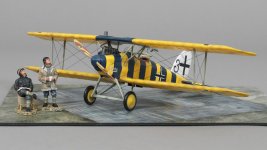
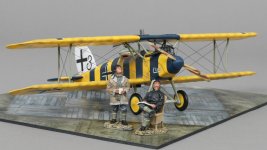
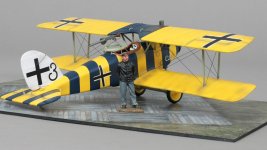
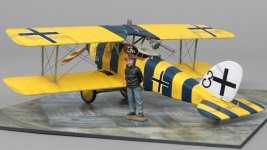
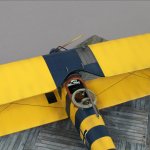
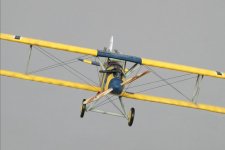
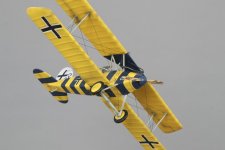
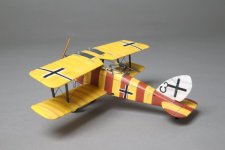
WOW702 Halberstadt CL.11
The Idflieg (Inspektion der Fliegertruppen - "Inspectorate of Flying Troops") was the bureau of the German Empire that oversaw German military aviation prior to and during World War I. Idflieg identified the airplanes flown by designating whether they were fighters (E for single wing or D for biplanes preceding model number: E.III, D-II etc.), 2-seater unarmed reconnaissance (B), and armed 2 seaters (C). In late 1916 Idflieg decided there was a need for a lighter version of their armed 2-seater airplanes, and designated them as Cl. It was a small and quite cramped aircraft for the crew. Pilot and observer were able to sit in the same cockpit, which made communication between the two very easy. However, due to the cramped conditions, it was hardly possible to take any equipment with you. As a result, many CL.II crews improvised and attached external load carriers around the entire cockpit to carry grenades, flare ammunition or other projectiles such as flying arrows. However, it was most dangerous for the observer when he had to defend himself on the rotating mount. Sometimes he even had to climb onto the seat or bend over the carriage ring to shoot.
The Halberstadt CL.II entered service in mid-1917, and proved extremely successful, its excellent manoeuvrability, rate of climb and excellent field of fire for its armament allowed it to match opposing single-seat fighters. The design was intended to provide a 2-seater airplane that could provide fighter protection for recon and bombing airplanes. By July of 1917, the Halberstadt Cl.II began to appear on the Western Front. They were grouped into units called Schustas to provide protection flights. Some individual Cl.IIs were assigned to other 2-seater recon or bombing groups to act as fighter escorts. The airplane was easy to fly, provided good visibility and was agile enough to hold its own against Allied fighters. By April, 1918 Idflieg reported that the Schustas preferred the Halberstadt Cl.II to all other types.
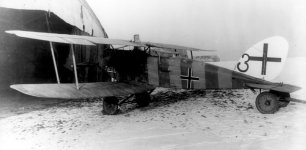
The 1/30 scale model we are releasing is Halberstadt Cl.II 5720/17 “3 Martha & Else”, flown by Max Niemann & Rudolf Kolodziej, Royal Prussian Schlasta 21, October 1918
We have 3 each of these 1/30 scale models available priced at $750 plus postage.
The figures and accessories shown are for scale comparison purposes only and are not included with the model.
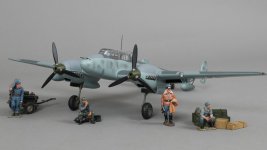
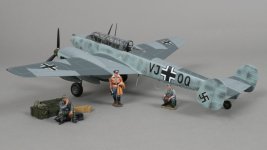
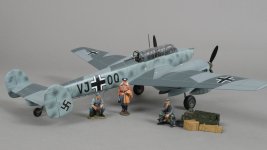
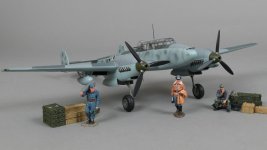
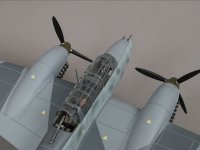
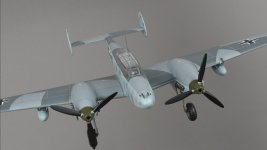
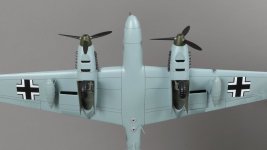
WOW684 Messerschmitt Bf 110 'Rudolf Hess'
The Messerschmitt Bf 110 was a twin engine heavy fighter armed with 2 x 20mm cannons, 4 x 7.92mm machine guns at the front and 1 x MG fitted to the rear for defence. The Bf 110 served with success in the early stages of the war during the Polish and France campaigns but was hopelessly outclassed by the RAF’s fighters during the Battle of Britain where is served as a bomber escort. Redeployed as a nightfighter in the West the Bf 110 was well suited to this role, especially when flown by aces like Major Schnaufer who claimed 121 victories solely in this type of aircraft. In other theatres such as the Balkans and the Russian front, the 110 soldiered on as a ground attack/fighter bomber and performed admirably. A 37mm cannon could also be fitted under the belly of the Bf 110 which made this a formidably armed aircraft when used in the ground attack or bomber interceptor role. The 110 was also adopted by Italy, Romania and Hungary amongst others with over 6000 aircraft being produced during its operational career.
This 1/30 scale model aircraft is one flown by Deputy Fuhrer Rudolf Hess, who on 10 May 1941 flew from an airfield at Augsburg-Haunstetten, in an attempt to negotiate peace between Great Britain and Germany. It was the last of several attempts to depart on his mission; previous efforts had to be called off due to mechanical problems or poor weather. Wearing a leather flying suit bearing the rank of captain, he brought along a supply of money and toiletries, a torch a camera, maps and charts, and a collection of 28 different medicines, as well as dextrose tablets to help ward off fatigue and an assortment of homoeopathic remedies. Hess crash landed in Scotland near to the Duke of Hamilton's residence, whom he had been in contact with. Hess was captured by the Home Guard and imprisoned in the tower of London and other secure establishments during the course of the war. His flight to the UK was for nothing, the British were not interested in negotiating with Hitler and had Hess tried for war crimes once the war had ended. He was sentenced to life imprisonment and served his sentence at Spandau prison until 1987 when he was found to have hung himself. He was the last resident of Spandau prison, which was then demolished shortly afterwards.
We have 2 models available of this historic aircraft priced at $999 plus postage.
The figures and accessories are shown for scale comparison purposes only and are not included.
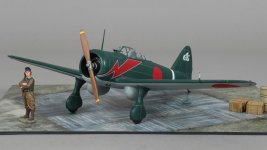
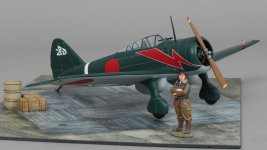
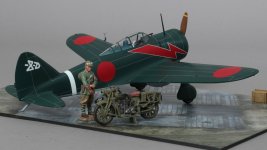
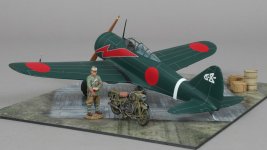
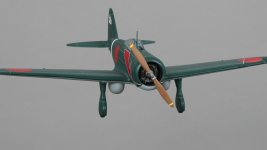
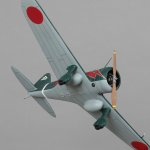
The Japanese Army’s first generation of monoplane fighter was Nakajima’s Ki-27. This type entered service in 1937, saw extensive service in China and continued into World War II.
The Nate possessed the extreme sort of maneuverability that would be typical even of more modern Japanese designs. With very light wing loading the type was nearly as maneuverable as the bi-plane it replaced (Ki-10) and almost as fast as those “more modern” foreign types. It achieved aerial superiority over China while facing mainly older western aircraft and a few newer Polikarpov I-16s. When all out war erupted between Japan and the Soviet Union in Nomonhan Mongolia during the summer of 1939, the Japanese Army again won air superiority. Even if this war went poorly for the Japanese on the ground they dominated the air until the last few weeks when the Soviets introduced some later model I-16s with pilot armour and self sealing fuel tanks.
Most of the West drew some poor conclusions from fighting in China. The Ki-27 was generally dismissed for its obsolescence by analysts who failed to consider what the next generation of Japanese designs might bring. When World War II did break out, the Ki-27 did indeed prove to be out of date; it generally performed poorly against Buffaloes in Singapore and Malaysia and P-40s over China and the Philippines. But its replacement was at hand and Nakajima’s much more capable Ki-43 Oscar (along with the Japanese Navy’s A6M Zero) shredded Allied air defences.
Our 1/30 scale model was one that saw active service over China in 1939 and flew against Soviet forces in the Nomonhan area.
The accessories and figures are shown for scale comparison purposes only and are not included.
We have 3 each of these 1/30 scale models available priced at $695 plus postage.
The figures and accessories are shown for scale comparison purposes only and are not included.
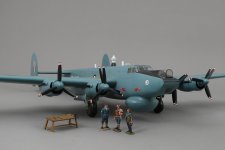
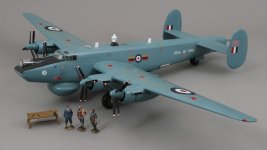
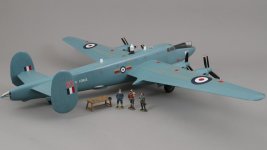
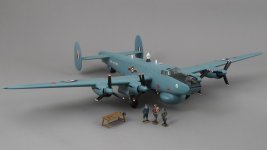
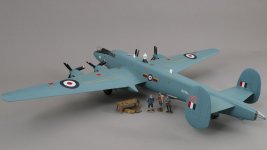
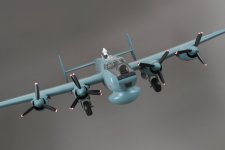
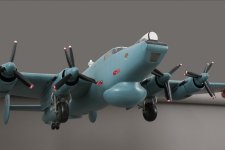
The Avro Shackleton was a British long-range maritime patrol aircraft which was used by the RAF. It was developed by Avro from the Lincoln bomber, which itself had been a development of the famous wartime Lancaster bomber.
Developed during the late 1940s as part of Britain’s military response to the rapid expansion of the Soviet Navy, in particular its submarine force. Produced as the primary type equipping RAF Coastal Command, the Type 696 as it was initially designated, incorporated major elements of the Lincoln, as well as the Avro Tudor airliner, and was furnished with an extensive electronics suite in order to perform the anti-submarine warfare (ASW) mission, along with much-improved crew facilities due to the long mission times involved in patrol work. There were 185 built and the type was named Shackleton, after the polar explorer Sir Ernest Shackleton.
The Shackleton entered operational service with the RAF in April 1951 and was used primarily in the ASW and MPA roles, but it was also frequently deployed as an aerial search and rescue (SAR) platform and for performing several other secondary roles such as mail delivery and as an ad-hoc cargo and troop-transport aircraft.
As the British government issued plans of their intention to scrap HMS Ark Royal, the navy were concerned that their ships would lose important airborne early warning capability, which was simply not an option. The solution was to put the radar units used on Ark Royal’s Fairey Gannets into the airframe of the trusty Avro Shackletons and although these were obviously land based aircraft, the impressive endurance of the Shackleton would greatly enhance the effectiveness of the navy’s airborne early warning capabilities.
Twelve Shackleton airframes were converted to AEW Mk.2 standard and operated in the colours of No.8 Squadron, originally at RAF Kinloss in early 1972. Following the completion of significant runway strengthening works at nearby RAF Lossiemouth, the Shackletons moved to Lossiemouth in August 1973, where they remained until the unit finally disbanded in 1991.
The intended replacement for the Shackleton, the British Aerospace Nimrod AEW3, suffered considerable development difficulties which culminated in it being cancelled in favour of an off-the-shelf purchase of the Boeing E-3 Sentry, finally allowing the last Avro Shackletons to be retired in 1991.
This 1/32 scale model is priced at $1600 plus postage.
That's all for this month, we sincerely hope you enjoy the pictures and would love to hear from you if any of these magnificent models appeal to you. They are all now on our website www.jumpthegunn.co.uk and can be paid for upfront or over an extended monthly period.
All Gunn Club members qualify for a 10% discount on the website listed price, joining is free so well worth registering.
I had the first version of the Halberstadt CL.II, WOW019, the first one was yellow/orange, like on most of the drawings that you can find in the internet, but I guess this new version is more accurate then the first edition. On historical fotos, the orange stripes are darker but not black like the German cross on the rudder. and only one cooler on the upper wing not twice
This site uses cookies to help personalise content, tailor your experience and to keep you logged in if you register.
By continuing to use this site, you are consenting to our use of cookies.