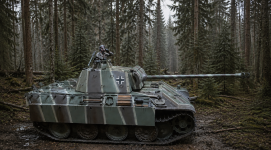
As regards the insertion of the 505 King Tiger with the Elefant ..this is what I found:
To pair your
Tiger II (King Tiger) from
schwere Panzer-Abteilung 505 with actual
Elefant heavy tank destroyers from
schwere Panzerjäger-Abteilung 653, you need to target a very narrow historical window on the
Eastern Front during
late summer and autumn 1944.
While these units did not operate in the exact same tactical company, they were both deployed under Army Group Center in Poland, specifically fighting to contain the Soviet Bagration and Lvov-Sandomierz Offensives.
The Historical Window: Poland, Late 1944 [
1,
2]
- The King Tigers: In July and August 1944, s.Pz.Abt. 505 was pulled back from the Eastern Front to be fully re-equipped with 45 brand-new Henschel-production Tiger II tanks. They returned to combat in September 1944, fighting defensive actions in the Narew River sector and East Prussia. [1, 2, 3, 4, 5]
- The Elefants: By mid-1944, s.Pz.Jg.Abt. 653 was the only unit operating the Elefant. Its 2nd and 3rd Companies were active in Poland and the Ukraine. By October 1944, the remaining operational Elefants were consolidated into a single sub-unit: schwere Panzerjäger-Kompanie 614, which continued fighting in Poland alongside various heavy tank elements. [1, 2, 3, 4, 5]
Modeling and Diorama Guide
If you are a scale modeler or wargamer pairing these two legendary heavyweights, keeping their unique unit markings accurate is crucial for a historically authentic presentation.
1. Unit Markings and Emblems
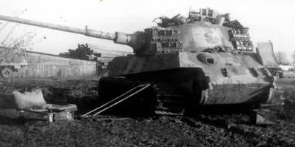
- s.Pz.Abt. 505 King Tiger: This unit featured one of the most famous and striking markings of the war: the "Charging Knight" logo. Crucially, for the King Tigers, the crew painted over the standard turret numbers and placed a large, stylized Charging Knight right on the sides of the turret. Small, three-digit tactical numbers were instead painted on the rear or sides of the turret stowage bin. [1, 2, 3]
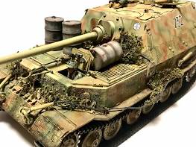
- s.Pz.Jg.Abt. 653 Elefant: This unit utilized a "Three-Arrow/Nibelungen" tactical insignia. The Elefants featured prominent, large three-digit numbers on the sides and rear of the massive armored fighting compartment casemate (e.g., black outlines with white/yellow fills). [1, 2]
2. Camouflage Schemes (Autumn 1944) [
1]
- King Tiger: Most factory-delivered September 1944 mid-production variants wore a standard German Three-Tone Ambush Camouflage (Hinterhalt-Tarnung). This consisted of a dark yellow (Dunkelgelb) base with olive green (Olivgrün) and reddish-brown (Rotbraun) patches, covered in small contrasting dots. They were also coated in factory-applied Zimmerit anti-magnetic paste.
- Elefant: Having survived since the Battle of Kursk (where they were called Ferdinands) and gone through retrofits in early 1944, these vehicles typically wore a softer, field-applied hard-edge or soft-spray green and brown pattern over faded dark yellow. They also featured a distinct, rough grid-pattern Zimmerit coating applied during their 1944 overhaul. [1, 2, 3, 4, 5]
3. Setting the Scene
To make the pairing authentic, build an
Autumn 1944 Poland setting:
- Terrain: Muddy dirt roads, waterlogged ditches, or deforested areas near the Narew or Vistula river networks.
- The Dynamic: Position the King Tiger pushing forward as an offensive breakthrough tank, while the slower, fixed-casemate Elefant provides long-range overwatch fire support from a static defile or tree line. [1, 2, 3]
Are you building a
scale model diorama, or are you setting this pairing up for a specific
historical tabletop wargame? Let me know so I can provide the exact kit recommendations or unit point values.