Battle for Arnhem.... (12 Viewers)

Humour is always a good tonic for grave situations. Would have been nice if he was connected, but no chance unfortunately. Robin.
 
Darkness came.

IMG_3276-1cs.JPG


Many houses were burning. Sapper Carpenter says that,

'The area around the bridge was becoming a sea of flame. The roar and crackle of flaming buildings and dancing shadows cast by the flames was like looking into Dante's inferno.'

The towers of the two nearby churches, the Eusebius and the St Walburgis, were both on fire. A bell in one of them clanged irregularly throughout the night as it swung in the wind.

So ended the second full day at the Arnhem bridge.

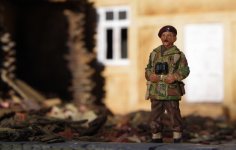
Lieutenant-Colonel Frost, who had been urged to reach and hold the bridge at all costs, wondered why no such priority had apparently been given to the Nijmegen bridge, from which there was still no sign of any fighting.
IMGP17321scxr (2022_11_01 16_49_51 UTC).JPG


The night passed relatively quietly; dawn came up dull and with a damp drizzle. Most of the original perimeter was still held, but the British positions were now virtually split into two parts divided by the ramp. The Germans allowed stretcher-bearers to pass in the open, but all other movement was extremely dangerous.

There was no redeployment of positions; each group would fight on until its building was destroyed.
IMGP54521rcsrz.JPG


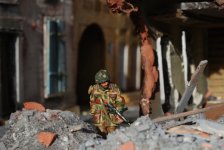
The pressure had nearly all been from the east and north until now, but the Germans started to press just as strongly from the west. Patrols sent out into the town on that side the previous day had found an absence of Germans and the high wall of the local prison on that side had partially shielded the British positions from shell fire from that quarter. But the Germans had blown a hole in the wall during the night and they started firing through it.

This development, together with the continuing German shelling from over the river, meant that the airborne positions were literally under fire from all sides and from within when the tanks cruised into the perimeter, as they would more frequently do during the day.

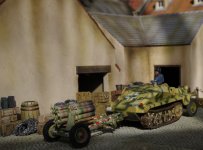
German artillery prepares to deploy ...
IMGP6423 = sr 0.JPG


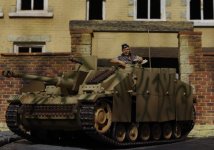
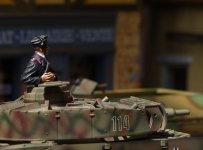
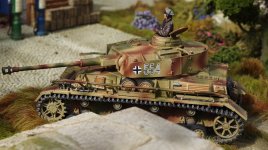
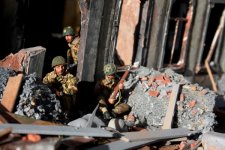
As does their armour ...
IMGP2480rcsrz (2).JPG
 
Ref: Arnhem - 1944: The Airborne Battle by M. Middlebrook​

Unless outside help arrived, there could only be one outcome to what was becoming a hopeless situation, however, there was little prospect of such help. More positively, the Brigade HQ signallers unexpectedly made direct contact with Divisional HQ that morning and a stream of messages was passed back and forth during the day.

IMG_9466 - crs 01.JPG


John Frost appealed for reinforcements, a surgical team, ammunition and food; he could not have been much impressed by Urquhart's unrealistic suggestion that local civilians should be sent out to collect some of the supply containers dropped by the RAF outside the town.

IMG_254111sr.JPG


The reports of action at the Arnhem bridge steadily became more confused. The exact sequence of events cannot be guaranteed, though all the incidents described here did happen on this day and, combined, they form a true reflection of what were to be the final hours of resistance.

The main feature was the relentless shelling, by both the German artillery and roving tanks, and the mortaring.

IMGP9104 - rsr 0.JPG

IMGP3278 - rsr 02.JPG

IMGP2446 - rsrc 01.JPG


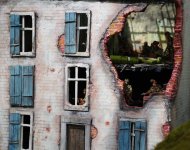
The Germans realized that it was quicker to destroy these stout Dutch buildings by fire than by blowing them slowly to pieces and were using more phosphorus shells to cause fires.
 
Ref: Arnhem - 1944: The Airborne Battle by M. Middlebrook​


Relief could only come from the south, but attempts by the 82nd US Airborne Division to capture the vital Nijmegen bridge had not yet been successful.

IMGP9108 scr0.JPG


When the first tank engines were heard on this morning, some optimist shouted,

'Thirty Corps is here'…

… but they were two German tanks.

IMGP8262 - rcs 0.JPG


Among the early victims of the shelling were members of the Brigade Defence Platoon, which in Sicily had captured and held a bridge until relieved. The first shell hit the corner of their house, and they soon had to leave with at least one man killed and their commander, Lieutenant Pat Barnett, wounded.

IMGP3551csr.JPG


One man, blown out of his position, but not seriously hurt, was the American, Lieutenant Harvey Todd, who claimed that he had killed sixteen Germans by now with his Springfield automatic carbine (which was much envied by British officers).

Another building to be hit was that occupied by the RASC platoon which had been protected until now by the prison wall. The defenders stood ready to repel an infantry attack through the gap in the wall but were instead struck by shell fire. Driver Jim Wild describes this:

The first shot hit the corner of the roof. It didn't explode there because the only resistance it had was the slates on the roof, but it left a hole nearly two yards across. The lads underneath it were showered with debris; I wouldn't like to repeat what they said. The shell exploded against the brickwork at the other end of the long room. We were all down on the floor. A lot of shrapnel was flying about, and I think one man was killed and one wounded. We decided to get out, down to the ground floor, when the second shell exploded against the front wall of the room we had been in; we would all have been killed if we had still been there’.

IMG_7105srzbc (2).JPG
 

Users who are viewing this thread

Back
Top