
Battle for Arnhem.... (1 Viewer)

Ref: Arnhem - 1944: The Airborne Battle by M. Middlebrook
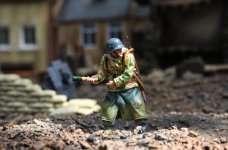
Monday 18th September 1944

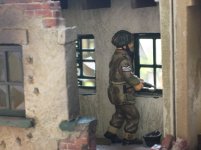
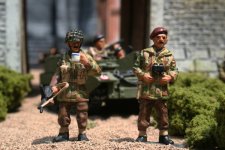
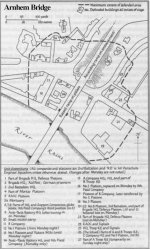
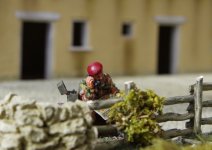
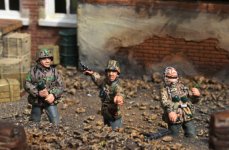
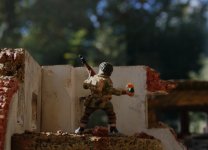
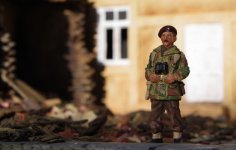
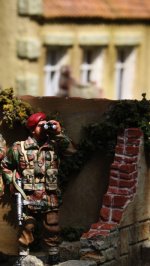
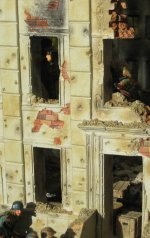
Only one corner of the perimeter had been attacked during the night. This was a library or small school on the eastern side of the lower ramp held by Captain Eric Mackay and some men of A Troop, 1st Parachute Squadron. There were several covered approaches to what was really an exposed outpost, and the Royal Engineers found it difficult to hold.​

IMGP4944-r1rs.JPG

Sapper George Needham says:

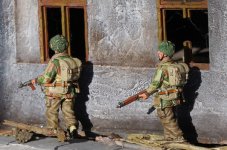
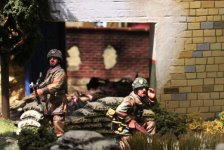
We had started to prepare it for defence, by smashing the windows and pulling down the curtains, but we had only been there about ten minutes when the Germans attacked, throwing grenades into the rooms.
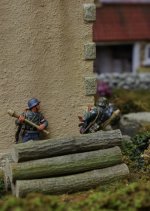
IMG_24691sr.JPG


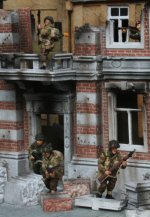
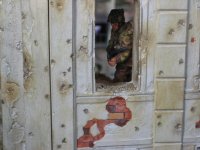
Captain Mackay decided that building was too vulnerable, so he ordered into the larger school building next door, where we joined B Troop. They objected and said,

'Bugger off; go find your own place,'

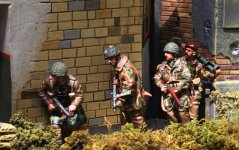
but Captain Mackay, being the man he was, persuaded them in no uncertain terms to let us in, and we started fortifying some of the empty rooms.
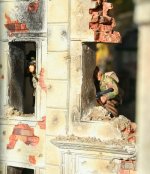
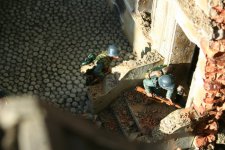
IMG_2466csr.JPG


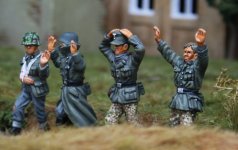
(The Royal Engineers were later joined in the school by Major 'Pongo' Lewis, the 3rd Battalion's company commander, and twelve of his men. There was some argument after the war between the sappers and the infantry over who was in command in this building, the Van Limburg Stirum School, during the subsequent three days of its defence. Captain Mackay, in an article in Blackwood's Magazine, claimed to have been in command and never mentioned the presence of the 3rd Battalion men. Major Lewis, in his short official report, did not mention the larger RE party. Both officers had been allocated this position separately, in the dark of that first night, and Major Lewis, though clearly the senior officer, probably did not interfere with Captain Mackay's handling of the larger sapper party.)
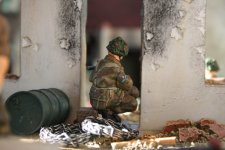
IMG_2737sr.JPG
 
Ref: Arnhem - 1944: The Airborne Battle by M. Middlebrook

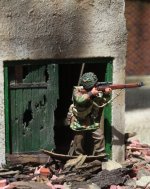
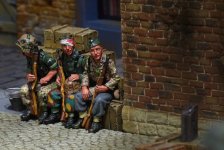
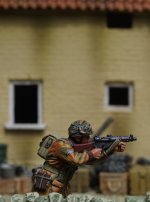
Dawn found the airborne men prepared for a day that would be full of incident. They had completed the preparations for the defence of the buildings they had occupied by breaking all the windows to avoid injury from flying glass, moving furniture to make barricades at the windows, filling baths and other receptacles with water for as long as the supply remained functioning; these were all basic lessons learned in their house-fighting training.

IMG_0528sr.JPG


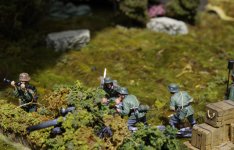
As soon as it started to get light, Major Munford wanted to begin registering the guns of No. 3 Battery of the Light Regiment on to likely targets:

IMG_4537 - rscr 0.JPG


'There was some reluctance to allow me to do this. Some people were still harking back to the time the paras had suffered from the results of 'drop-shorts' in North Africa, not by the Light Regiment. But I persisted and was allowed to register on the approach road at the south end of the bridge, only about six rounds, but we got both troops ranged on to it and recorded it'.

IMG_2554ccsr.JPG


'Sheriff' Thompson, back at Oosterbeek, said it should be recorded as 'Mike One'; 'Mike' was 'M' for Munford.

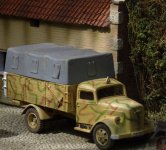
Our signals back to the battery were working well. The first intruder into the area was a lorry 'full of dustbins clattering in the back', which drove in between the buildings overlooking the ramp and the offices which Brigade HQ was occupying. Trigger-happy airborne men shot it up from both sides; the driver, presumably a Dutchman on a routine refuse-collection round, was probably killed. A similar fate befell three German lorries which appeared, probably also on a routine errand and not knowing of the British presence.​

IMGP1026 - rsrc 01.JPG

IMG_3784 - csr 01.JPG
 
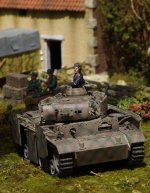
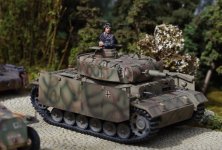
The German attacks soon started, mainly from the east. They did not yet know the precise strength or location of the British force, and the first attacks were only tentative probes by some old Mark III and IV tanks supported by infantry which were easily beaten off.

IMGP1552 - crsr 0.JPG


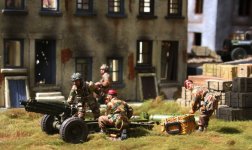
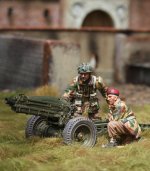
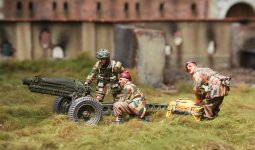
One tank reached the road under the bridge ramp and was fired upon by an anti-tank gun. Lieutenant Arvian Llewellyn-Jones, watching from a nearby building, describes how an early lesson about the recoil of a gun in a street was learned:

The gun spades were not into the pavement edge, nor firm against any strong barrier. The gun was laid, the order to fire given, and when fired ran back about fifty yards, injuring two of the crew. There was no visible damage to the tank.

IMG_3866 - rsc 0.JPG


It remained hidden in part of the gloom of the underpass of the bridge. The gun was recovered with some difficulty. This time it was firmly wedged. The Battery Office clerk, who had never fired a gun in his life, was sent out to help man the gun. This time the tank under the bridge advanced into full view and looked to be deploying its gun straight at the 6-pounder. We fired first. The aim was true; the tank was hit and it slewed and blocked the road’.

IMGP16461rcsL (2).JPG


These early actions were followed by a period of relative calm, described by John Frost as,

'a time when I felt everything was going according to plan, with no serious opposition yet and everything under control'.

IMG_9599 = sc 0.JPG


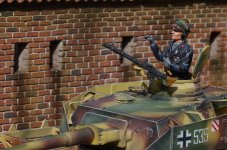
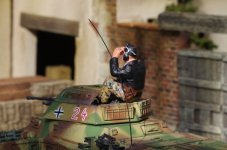
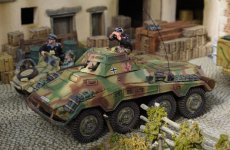
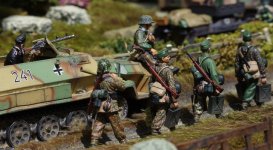
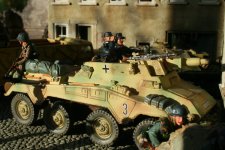
Hauptsturmführer Viktor Graebner was the commander of the 9th SS Panzer Division's Reconnaissance Battalion …

IMGP6605csrz.JPG


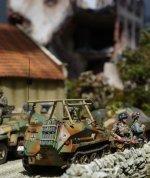
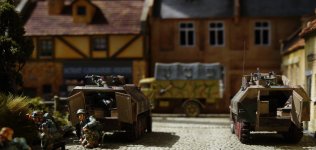
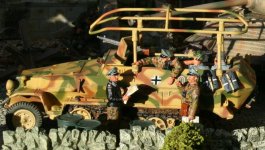
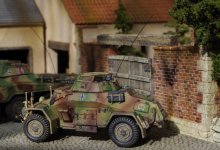
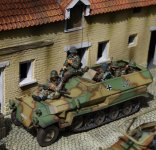
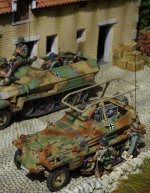
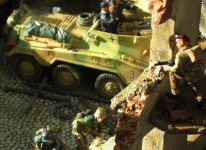
... a unit of first-class troops well equipped with twenty-two armoured cars and half-tracked armoured personnel carriers.

IMGP3002-2scr.JPG

IMGP8321 - rsc 0 (2).JPG

img_39682srx.jpg

Only the previous day his divisional commander had presented him with the ribbon and emblem of the Knight's Cross, awarded to him for bravery in Normandy. He had then led his unit over the bridge, before the British arrived there, on a sweep down the main road to Nijmegen.

Finding that area all clear, he turned back and was now preparing to return over the bridge to reach his divisional command post in Arnhem. He knew the British were at the north end of the bridge now; whether he actually intended to mount an attack or just dash through the British positions is not known.

IMGP6568rcsrz.JPG
 
Look-outs in the top rooms of the houses occupied by the airborne men drew to the attention of their officers the column of vehicles assembling on the bridge approach. The identification of the vehicles as German swiftly put paid to the initial hope that this might be the head of the ground-force column making excellent time and arriving to relieve the airborne force.

Major Munford saw that the German vehicles would have to pass through the area he had registered as a target, and his signaller immediately made contact with the battery at Oosterbeek.

IMGP8206csrz.JPG

Dennis Munford says:

I received permission to open fire and, when the German column moved off, all I had to do was call, 'Target – Mike One', and the boys at the battery did the rest. There was no need for further correction. The Germans had to drive through it. I ordered a cease-fire when they left the Mike One area and came on to the bridge; I didn't want to damage the bridge.

IMG_2535csr.JPG

The artillery fire was accurate. Some German motorcyclists were seen to be hit, but the shells were too light to inflict much damage on the armoured vehicles”.

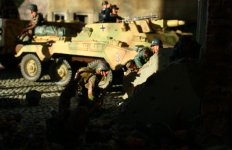
The first part of Graebner's force set off over the bridge at top speed. These leading vehicles were armoured cars which threaded their way round the still burning lorries from the previous night's action and over the string of mines laid on the roadway during the night, but these failed to stop the vehicles.

IMGP6993csrz.JPG

The airborne men held their fire until the last moment, and some of those first armoured cars drove straight on through to the town without being stopped, but then the order to open fire was given and none of the other armoured cars survived the resulting hail of fire.

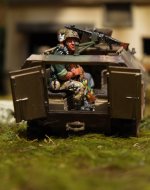
More and more of the German unit were committed to reinforce the attack, including half-tracks packed with soldiers, some protected by armoured coverings but others with open tops.

IMGP3025-1rcs.JPG

IMGP3019-2rs.JPG

 
To continue the earlier content list of this diodrama thread:

PageDateArnhem Thread Contents
7317 Sept 1944The U.S. 101st Airborne Division had to take bridges over:

1. the Wilhelmina Canal at Son

2. the Dommel at St-Oedenrode

3. the twin waterways of the Aa and Zuid-Willemsvaart Canal near Veghel

Initial landings and attacks.
7317 Sept 1944A secondary target of the 502nd Regiment was the bridge near Best - General Taylor felt that taking Best would give him two bridges across the Wilhelmina Canal as insurance. Intelligence told Taylor that there were only light garrison forces in the area, so Taylor felt that one company could be spared for the task.
7317 Sept 1944H Company of 3/502 PIR was chosen, with 3rd Platoon C Company, 326 Engineers and a section of machine guns from Battalion HQ as reinforcements, to take and hold the road and rail bridges. Captain Robert Jones was in command.
7317 Sept 1944Jones was about to overwhelm the small group of defenders when 12 trucks halted their journey and disgorged around 300 infantry from 59thDivision. They were a different kampfegruppe on their way south, the Germans were now stronger so the Paras dig in.
7318 Sept 1944Son bridge was blown on the 17th and now Taylor was left with no bridges over the Wilhelmina Canal, as the Best bridge was blown at 11.00 on the 18th.


PageDateArnhem Thread Contents
7417 – 18 Sept
1944
The German forces around Best were some of Major General Walter Poppe’s 59th Infantry Division of the 15th Army.
7417 – 18 September
1944
The battle around Best intensified for 3/502. 2/502 PIR were able to help in time, but suffered losses in a counter-attack.
74The two other bridges that the 506th Regiment were originally to secure, had been blown up several days earlier, before the Market-Garden assault.
74XXX Corps were a day late after Son Bridge was blown, only reaching Valkensvaad.
74506 PIR take Eindhoven and joined at noon on 18 September by the Household Cavalry. Message - 'Stable boys' link up with 'Feathered Friends'.
74Evening of 18th to 0600 on the 19th, Bailey bridge completed.
74Although 502 PIR did not realise it yet, by closing the Boxtel – Eindhoven road and forcing the destruction of Best Bridge, they specifically prevented reinforcement of Eindhoven at a crucial time.
7418 Sept 1944So, by the last light on the 18th September, the main body of the Guards Armoured Division had closed up to the Wilhelmina Canal and other 101st objectives were secure. As a result, General Taylor could plan to reinforce 2/502 at Best with more paratroopers and British tanks.
7419 Sept 1944The Best battle had escalated by Tuesday 19th September to the point where Taylor ordered Brigadier General Higgins to take control.

His orders were, ‘to clear up once and for all the Best situation’. Reinforcement came with him, glider troops from 2/327 and 3/327 GIR.
He was also given armour, Cromwell tanks of B and C Squadrons 15/19 Hussars, closely followed by a battery of SP Artillery from 86th (Hertfordshire Yeomanry) Field Regiment RA.
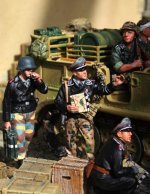
7419 Sept 1944
The Allies combine to good effect and overcome the defence, taking several hundred German prisoners.
PageDateArnhem Thread Contents
7519 Sept 1944Around fifty Germans managed to advance and attack the 502 PIR CP, but were beaten off.
7519 Sept 1944B Sqdn 15/19 Hussars were however, still busy and cleared enemy artillery.
7519 Sept 19442/327 GIR had numerous short range encounters in the woods and took casualties.
To the north, 3/327 GIR’s lead unit was Company G, supported by C Sqdn 15/19 Hussars. Enemy mortar fire was very accurate, so it was suspected it was observed from Best church steeple. 3/327 GIR took position for all round defence around the road into Best which was ominously quiet.
75An excerpt from the 502 PIR after action report read:

The area covered by the Regiment on the 17th, 18th and 19th September had contained 2,500 enemy troops. Of these, 1042 were captured and an estimated 800 killed. This figure was reported by a British unit, which later occupied the area and buried the dead.

Reinforcing his normal compliment of machine guns and mortars, the enemy had eight 88mm guns, two 75mm anti-tank guns and five 20mm anti-aircraft guns. Casualties in the Regiment were particularly heavy ... 29 officers and 420 enlisted men’.


After three days of fighting, PIR 502 needed rest.
75At post #1459 I started the tale of 2nd platoon of 3/502 PIR as they approached the Best Bridge area. I now return to their story.

They only managed to rejoin the rest of 3/502 PIR on the 19th. They were feared to be lost for two days by their HQ. When they did rejoin they spoke of events in the forest. Earlier that day Lt Wierzbowski’s platoon was still isolated in the woods near the bridge. German infantry reached grenade range of them, in the morning mist.

Sergeant Betras threw a grenade, then several others threw. But the Germans had beaten them to the throw and grenades were already on their way to the foxholes. Two hit the top of the embankment.’

They were thrown back, but another exploded on Engineer Private Laino’s machine gun.

It blew his eye out, blinded the other eye and made a pulp of his face .... another grenade came over ....... hit Laino on the knee and bounced off into his foxhole. Laino, still blinded, reached down groping for it, found it and tossed it from his foxhole just a split second before it exploded.’

Private Laino earned the Silver Star for his coolness in this action.
75PFC Joe Mann of 2/502 PIR was awarded a posthumous Congressional Medal of Honor.

His citation reads:


He distinguished himself by conspicuous gallantry above and beyond the call of duty. On 18 September 1944, in the vicinity of Best, Holland, his platoon, attempting to seize the bridge across the Wilhelmina Canal, was surrounded and isolated by an enemy force greatly superior in personnel and firepower.

Acting as lead scout, Pfc. Mann boldly crept to within rocket-launcher range of an enemy artillery position and, in the face of heavy enemy fire, destroyed an 88mm. gun and an ammunition dump.

Completely disregarding the great danger involved, he remained in his exposed position, and, with his M-1 rifle, killed the enemy one by one until he was wounded 4 times.

Taken to a covered position, he insisted on returning to a forward position to stand guard during the night. On the following morning the enemy launched a concerted attack and advanced to within a few yards of the position, throwing hand grenades as they approached.

One of these landed within a few feet of Pfc. Mann. Unable to raise his arms, which were bandaged to his body, he yelled "grenade" and threw his body over the grenade, and as it exploded, died.

His outstanding gallantry above and beyond the call of duty and his magnificent conduct were an everlasting inspiration to his comrades for whom he gave his life.

7520 Sept 1944Skirmish at Neunen, 20th September 1944 between 506 PIR and 15th / 19th Kings Royal Hussars (11th Armoured Division) and elements of 107th PB. (Small skirmish made famous in ‘Band of Brothers’).
 
7519 Sept 1944Victoria Cross Citation
David Samuel Anthony Lord VC DFC

The full citation for Lord's VC appeared in a supplement to the London Gazette on 9 November 1945, reading: Air Ministry, 13 November 1945.

"The KING has been graciously pleased to confer the VICTORIA CROSS on the undermentioned officer in recognition of most conspicuous bravery:—

Flight Lieutenant David Samuel Anthony LORD, D.F.C. (49149), R.A.F., 271 Sqn. (deceased).

Flight Lieutenant Lord was pilot and captain of a Dakota aircraft detailed to drop supplies at Arnhem on the afternoon of 19 September 1944. Our airborne troops had been surrounded and were being pressed into a small area defended by a large number of anti-aircraft guns. Air crews were warned that intense opposition would be met over the dropping zone. To ensure accuracy they were ordered to fly at 900 feet when dropping their containers.


While flying at 1,500 feet near Arnhem the starboard wing of Flight Lieutenant Lord's aircraft was twice hit by anti-aircraft fire. The starboard engine was set on fire. He would have been justified in leaving the main stream of supply aircraft and continuing at the same height or even abandoning his aircraft. But on learning that his crew were uninjured and that the dropping zone would be reached in three minutes he said he would complete his mission, as the troops were in dire need of supplies.


By now the starboard engine was burning furiously. Flight Lieutenant Lord came down to 900 feet, where he was singled out for the concentrated fire of all the anti-aircraft guns. On reaching the dropping zone he kept the aircraft on a straight, and level course while supplies were dropped. At the end of the run, he was told that two containers remained. Although he must have known that the collapse of the starboard wing could not be long delayed, Flight Lieutenant Lord circled, rejoined the stream of aircraft and made a second run to drop the remaining supplies. These manoeuvres took eight minutes in all, the aircraft being continuously under heavy anti-aircraft fire.

His task completed, Flight Lieutenant Lord ordered his crew to abandon the Dakota, making no attempt himself to leave the aircraft, which was down to 500 feet. A few seconds later, the starboard wing collapsed and the aircraft fell in flames. There was only one survivor, who was flung out while assisting other members of the crew to put on their parachutes.


By continuing his mission in a damaged and burning aircraft, descending to drop the supplies accurately, returning to the dropping zone a second time and, finally, remaining at the controls to give his crew a chance of escape, Flight Lieutenant Lord displayed supreme valour and self-sacrifice".
 

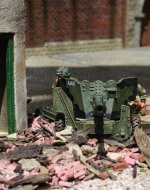
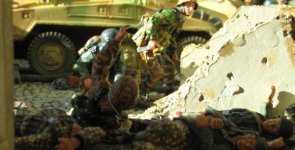
Nearly all the German vehicles were hit and stopped in a great tangle on the ramp between the houses on both sides occupied by the 2nd Battalion's A Company and also overlooked by the Brigade HQ and other buildings. PIATs accounted for some of these vehicles, but much of the damage was caused by two anti-tank guns. One of these, Sergeant O'Neill's gun of B Troop, was at a corner of the Brigade HQ building.

IMG_8299csrz.JPG

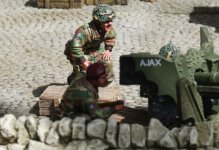
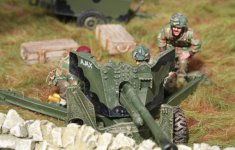
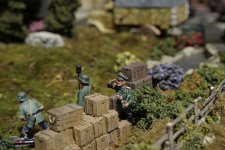
The other 6-pounder was that of Sergeant Cyril Robson of C Troop, which was in a street closer to the river on the west side of the bridge and considerably below the level of the ramp. Directed by Lieutenant Tony Cox in the window of the house above him, Robson fired solid-shot shells at the parapet at the side of the bridge until he cut a V-shaped section away and was then able to fire into the sides of the German vehicles passing the gap.

IMG_8347csrz.JPG


It is believed that Robson's gun destroyed more of the attacking vehicles than any other weapon. The Germans in the half-track personnel carriers which were hit or found their way blocked were exposed to a hail of small-arms fire, trapped in their vehicles or spilling out on to the open stretch of the ramp, unable to deploy into shelter.

IMG_1753 = rrcs 01.JPG


They were slaughtered. One of the early victims was seen to be flung out on to the roadway and literally cut to pieces by a hail of fire.

Some of the vehicles toppled over or slewed off the embankment of the lower ramp, allowing the airborne men in the buildings there to join in the execution.

IMG_8519csrx.JPG


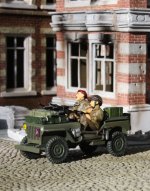
Nearly everyone in the British garrison joined in the firing. Major Freddie Gough was seen enthusiastically firing one of the machine-guns on his Reconnaissance Squadron jeep.

IMG_2105 = csr 0.JPG

It would be ironic if it was one of his shots that killed his opposite number, because Hauptsturmführer Graebner was among the German dead.​
 
This particular action on the bridge was very memorable from the film. Chaos and pandemonium. Robin.
 

Users who are viewing this thread

Back
Top