

- Joined
- Feb 2, 2011
- Messages
- 2,498
JJDESIGNS NEWS UPDATE 27th APRIL 2026
THE ANGLO ZULU WAR
VOLUNTEERS, IRREGULARS AND AUXILIARIES
NATAL CARABINEERS
With the beginning of the Crimean war, what was a small British garrison in the Natal colony was under the threat of being withdrawn for service in the Crimea, which would leave the colonists undefended.
The Natal government recognizing this threat settled on a system of volunteer Corps. As the settlers were still trying to establish themselves a militia law involving compulsory periods of service would have caused great hardship.
In 1854 the establishment of a Volunteer corps was set up. Each corps elected its own officers, drew up its own rules and bylaws, and chose a headquarters.
Each man paid for his own uniform and in mounted units provided his own horse and saddlery.
The government supplied arms and ammunition.

In 1879, as Britain prepared for the war in Zululand, 753 men served in 15 separate corps. This was broken up into 3 infantry, 1 artillery and 11 mounted units.
Lord Chelmsford used these corps to supplement his manpower, selecting eight of the mounted corps to join his invading columns, whilst the others remained in Natal for local defense.

The Natal Carabineers were formed in 1855 and their headquarters were at Pietermaritzburg, which was the capital of Natal.
Previous engagements had taken place before the Zulu War, with the disastrous engagement at Bushman’s River Pass against the amaHlubi of Langalibalele kaMthimkhulu where three men were lost.

The Natal Carabineers wore a uniform of dark blue cloth, the plain tunic having a white collar and white pointed cuffs, with twisted white shoulder cords and white metal buttons held the equipment in place.
Trousers were of the same dark blue material with a broad white stripe down the outside seam.

Officers wore a dark blue tunic of the same material decorated with five rows of black mohair braid, ending in trefoil knots and fastened by olivets.
The bugler had a similar tunic but was decorated with white braid.
All ranks wore a white helmet with white metal fittings of a spike and badge.

The Natal Carabineers can best be described as a type of “light Mounted Infantry” regiment. The classification as “Carabineer” is taken from troops armed with carbines which were introduced during the Napoleonic wars.
They were to join the British Regular Colonial army under Major General Lord Frederick Chelmsford, and formed a portion of the central column which invaded the Zulu territory.
At the Battle of Isandhlwana in 1879, they mustered a total of 85 officers and men. Twenty Three men were lost during the battle.

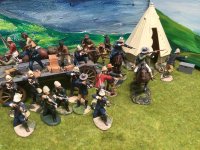
The NATAL CARABINEER sets are ideal to add on to any Battle of Isandhlwana displays, or as a display with some of the new JJD Zulus which will be previewed later this year.
Most of the current zulu sets which have been released will be restocked.
The first of the ten sets of Natal Carabineers will be available this Autumn.
Best wishes,
john jenkins
THE ANGLO ZULU WAR
VOLUNTEERS, IRREGULARS AND AUXILIARIES
NATAL CARABINEERS
With the beginning of the Crimean war, what was a small British garrison in the Natal colony was under the threat of being withdrawn for service in the Crimea, which would leave the colonists undefended.
The Natal government recognizing this threat settled on a system of volunteer Corps. As the settlers were still trying to establish themselves a militia law involving compulsory periods of service would have caused great hardship.
In 1854 the establishment of a Volunteer corps was set up. Each corps elected its own officers, drew up its own rules and bylaws, and chose a headquarters.
Each man paid for his own uniform and in mounted units provided his own horse and saddlery.
The government supplied arms and ammunition.
In 1879, as Britain prepared for the war in Zululand, 753 men served in 15 separate corps. This was broken up into 3 infantry, 1 artillery and 11 mounted units.
Lord Chelmsford used these corps to supplement his manpower, selecting eight of the mounted corps to join his invading columns, whilst the others remained in Natal for local defense.
The Natal Carabineers were formed in 1855 and their headquarters were at Pietermaritzburg, which was the capital of Natal.
Previous engagements had taken place before the Zulu War, with the disastrous engagement at Bushman’s River Pass against the amaHlubi of Langalibalele kaMthimkhulu where three men were lost.
The Natal Carabineers wore a uniform of dark blue cloth, the plain tunic having a white collar and white pointed cuffs, with twisted white shoulder cords and white metal buttons held the equipment in place.
Trousers were of the same dark blue material with a broad white stripe down the outside seam.
Officers wore a dark blue tunic of the same material decorated with five rows of black mohair braid, ending in trefoil knots and fastened by olivets.
The bugler had a similar tunic but was decorated with white braid.
All ranks wore a white helmet with white metal fittings of a spike and badge.
The Natal Carabineers can best be described as a type of “light Mounted Infantry” regiment. The classification as “Carabineer” is taken from troops armed with carbines which were introduced during the Napoleonic wars.
They were to join the British Regular Colonial army under Major General Lord Frederick Chelmsford, and formed a portion of the central column which invaded the Zulu territory.
At the Battle of Isandhlwana in 1879, they mustered a total of 85 officers and men. Twenty Three men were lost during the battle.
The NATAL CARABINEER sets are ideal to add on to any Battle of Isandhlwana displays, or as a display with some of the new JJD Zulus which will be previewed later this year.
Most of the current zulu sets which have been released will be restocked.
The first of the ten sets of Natal Carabineers will be available this Autumn.
Best wishes,
john jenkins