
Building and detailing the M4A3 Sherman tank in 1/30th scale (1 Viewer)

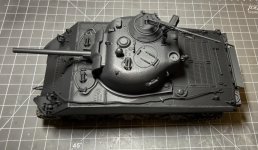
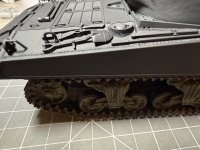
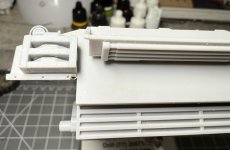
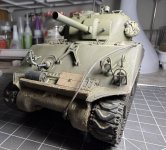
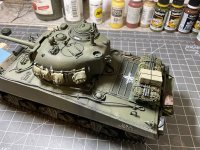
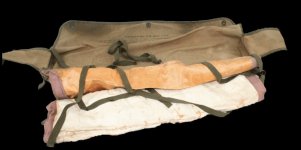
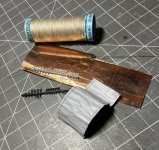
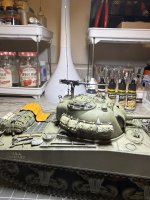
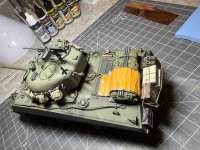
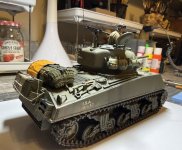
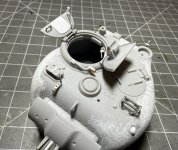
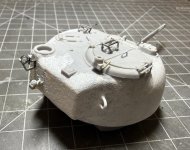
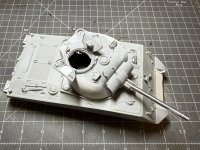
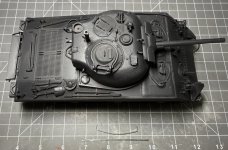
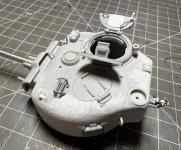
When I finished adding most of the details to the upper hull and turret I needed to start priming, painting and weathering the upper hull of the M4A3. One of the features I noticed in many of the wartime photographs were the addition of steel rod or flat stock added to the turrets for stowing various packs, blanket rolls and other soft stowage. In addition other items such as helmets or even rubber overshoes are hung up high to be more accessible and to an extant above the mud. I decided that in order to insure that it would be durable during handling that I would hammer out a piece of iron wire to approximate the shape and size I needed. Once the turret is painted I can add the support by gluing the ends into holes drilled into the turret and add stowage. I also decided to replace the headlight, tail light and siren guards with some prints that were a bit more refined and detailed up the tool tie downs. I am sure that before it is all said and done I will add other similar improvements as I add stowage. An easy to add detail at this point was to drill the mounting holes along the lower edge of the hull where the fenders would have been mounted. I also remembered to add the small exit pipe for the auxiliary generator that vented out of the crew compartment at the left rear fender. It was made from small brass tubing that had the walls thinned down from the. Inside and then was crimped to an oval with small pliers to simulate that detail on a real vehicle. I think I will also try to improve the exhaust deflector, but more on that later. The last thing I did before priming the tank was to drill the drain holes through the vertical splash guards that protects the turret and various filler caps, a small but interesting detail.
 

Attachments

  • IMG_6754.jpeg
    IMG_6754.jpeg
    147.1 KB · Views: 6
  • IMG_6757.jpeg
    IMG_6757.jpeg
    130.1 KB · Views: 6
  • IMG_6758.jpeg
    IMG_6758.jpeg
    142.4 KB · Views: 6
  • IMG_6755.jpeg
    IMG_6755.jpeg
    80.5 KB · Views: 6
Very interesting to see the work that goes into these products and others.
Thanks Ken. We met once but you've met everybody so no foul if you don't remember. We liked your round-based dios at the time.
Paddy for Dad&me
 
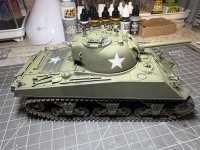
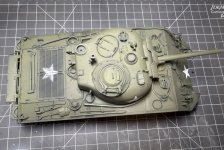
I started to apply various shades of Olive Drab paint over the black primer with my airbrush on the main hull and turret. The transformation was startling when compared to the flat black primer coat and it is now starting to look the part of a small version of this classic piece of World War Two American armor. I used three different shade variations of OD from a Vallejo US armor paint set that I am pretty happy with and the weathering will shift the color a bit more before it is all said and done. Before I went too much further I decided to use the decal sheet to create painting stencils for the white identification stars. Using masks and spray painting the stars white over the base color really looks good. Looking at vehicles from the late 1944 to 1945 period, the stars often only appear on the front of the transmission housing, the rear deck and on occasion the turret sides. On many of the 76mm armed M4A3s there were small stars on top of the larger turret. The upper surface international recognition markings combined with the brightly colored AL-140 and AL-141 Air Identification panels were important to help the roaming Allied fighter bombers to recognized friendly forces during the fast advances toward Germany. When vehicles had the added turret racks added I suspect that the various musette bags, bedrolls and other items attached minimized the visibility of the stars, but with that said the turret stars are often absent. I think the next vehicle I finish will not have markings on the turret.

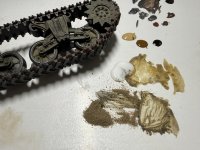
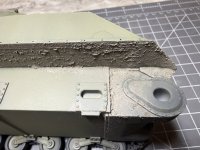
I also started to add weathering such as chipping, scratches, oil and gas spills along with the first applications of light mud effects. I used a combination of water based acrylic paint, artist matte medium and modeling paste along with some very fine sifted soil for the mud and I will give a little more detail on additional techniques next.
 

Attachments

  • IMG_6779.jpeg
    IMG_6779.jpeg
    174 KB · Views: 6
  • IMG_6777.jpeg
    IMG_6777.jpeg
    151.2 KB · Views: 7
  • IMG_6780.jpeg
    IMG_6780.jpeg
    157 KB · Views: 6
  • IMG_6778.jpeg
    IMG_6778.jpeg
    135.6 KB · Views: 6
Embarrassingly enough, a lot of the technical details are lost on me. But my subconscious registers them and they, for me, separate a tank model from a miniaturized real tank. Latter immediately demand attention and respect and in any modeling show stick out. If AFV modeling switched from 1/32 or 1/35 to 1/30, I would be all in.
Great post. Would love to see 1/30 scale kits too. Thanks for sharing all your skills and knowledge Ken, its greatly appreciated. Before this thread, I had never heard of Campaign Miniatures and their wonderful kits. Given AV prices, building your own 1/30 scale vehicles is certainly an attractive option these days.

I have been given a 1/35 'Dragon' Normandy Sherman kit to build, however its just too small to work with the likes of K&C or even FL and Britains figures.

Cheers
 
Thanks, I hoped that some of you might enjoy following the build here. There were a couple 1/30th scale kits of German armor released in the 1970s when I was a clerk in a hobby shop and they occasionally show up in E-bay listings and are good starting points if you are willing to do a little work and detailing. The Campaign Miniatures range was something I started while working at W. Britain to allow folks to consider adding to their collections with the ability to detail and mark them for different units at a reasonable cost. I noticed that the prices have been reduced making them even more attractive to use as a basis for conversions. The M-18 and M3A1 Halftrack build into a really nice vehicles with lots of detail too, but they are in limited supply and I would recommend getting these while they are still availible.
 
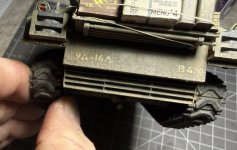
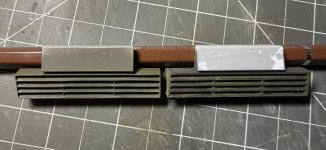
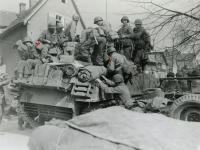
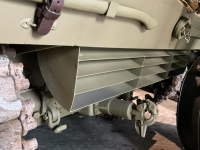
One of the kit parts I was not really very happy with was the exhaust deflector at the lower rear end of the tank. This style deflector first showed up on the Ford built tanks powered by the GAA V8 engine and continued to be used thru the production of the M4A3. An armored version was fitted to vehicles by 1945 and most of the post war rebuilds included this armored deflector too. The simulation of the light steel deflector in the kit was a bit too robust and shallow, but honestly I was intimidated by the amount of work it would take to scratch build one out of styrene plastic. The advantage of with working on a small model for so long is that you have plenty of time to consider how you might approach each part of the project. Early on I decided that it was in an area of the model that few people really study, so I just used the part as it came out of the box. As I approached the end of the build it bothered me so much that I thought I might try to improve the exposed cross section that represented the deflector by simply scraping down the exposed edge the way I did with the front fenders. I took a copy of the part from one of the other vehicles I was working on and after a little over an hour I had a part that looked better. But the real proof would be in how it looked on the model after painting. I quickly airbrushed the modified piece and was pleased enough that I immediately modified a second one that turned out even better. I removed the old one from the finished tank and replaced it so I could weather it in place.

Now with that nagging detail improved it was time to wrap up the final details I had been thinking about and I will cover that in my next post.
 

Attachments

  • IMG_0947.jpeg
    IMG_0947.jpeg
    159.3 KB · Views: 6
  • IMG_0957.jpeg
    IMG_0957.jpeg
    108.3 KB · Views: 6
  • IMG_0960.jpeg
    IMG_0960.jpeg
    109.7 KB · Views: 6
  • IMG_6483.png
    IMG_6483.png
    1.1 MB · Views: 6
  • IMG_6687.png
    IMG_6687.png
    1.5 MB · Views: 6
I used the kit decals for the unit designations and the registration numbers, in part because I haven’t located my photo etched stencils since the move. All in all, with the use of Micro Scale setting solutions they look pretty good and once I added the weathering they are convincing, but I am still looking forward to finding my stencils for the next ones!
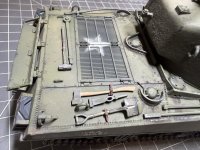
I painted the tools and decided to show both painted and unpainted handles with some wood graining and chipped paint for variety. Both types of finish are period correct, but the two different styles adds interest and I can mix it up on the other two companion vehicles.
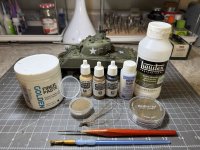
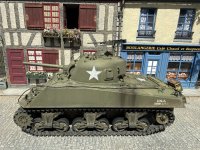
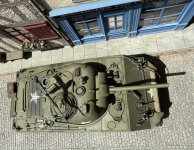
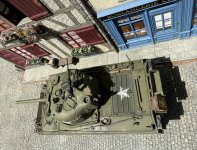
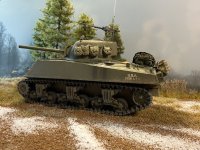
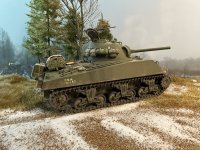
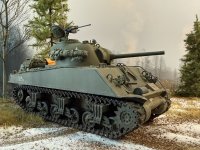
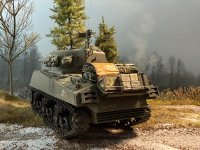
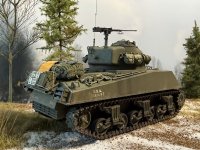
As mentioned yesterday I ended up using a number of different products on my bench to replicate dried and damp mud. I am sure that I will add a little more here and there once the stowage is attached, especially remnants on the rubber track pads. I limited the number of basic colors but enhanced the final texture and appearance by using artists acrylic fiber paste, artist matte medium, fine sifted soil, dried grass roots and Pan Pastels pigment powders. To achieve a damp soil accumulation, especially on the lower hull sides, I mixed Microscale acrylic gloss to a darker shade of the basic paint mix (more black and brown) and diluted it with water for localized washes. When dried it leaves a darker sheen simulating damp soil. I decided to use a similar technique for oil and gas stains.. something that all of the operational vehicles show evidence of. I am really happy with the effect, including the slight sheen on the engine deck near the fuel and oil filler caps. The key was to pre-dampen the area that I was streaking with water so the Microgloss and paint wash would flow nicely. Because it was a matte paint surface the water does not bead up allowing the wash to diffuse. I always start light and add more color if needed. I always watch Workshop Wednesday at the Australian Armor and Artillery Museum and pick up lots of interring surface staining details on their operational vehicles…and they are keeping them clean compared to vehicle in a combat environment! I know that enamels and oil paints are useful for these types of weathering too, but again, most of my paint is still packed away in boxes after our move down south. I took a couple of quick overall photos of the vehicle on a diorama I built several years ago to put the tank into a scale environment that I thought you might enjoy.
 

Attachments

  • IMG_6783.jpeg
    IMG_6783.jpeg
    159.2 KB · Views: 7
  • IMG_6784.jpeg
    IMG_6784.jpeg
    175.6 KB · Views: 6
  • IMG_6785.jpeg
    IMG_6785.jpeg
    247.9 KB · Views: 7
  • IMG_6786.jpeg
    IMG_6786.jpeg
    265.5 KB · Views: 6
  • IMG_6787.jpeg
    IMG_6787.jpeg
    266.4 KB · Views: 7
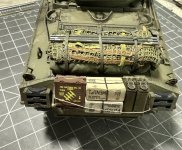
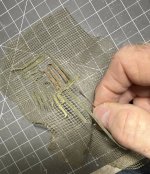
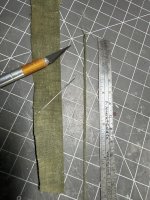
I am now down to adding small details and the stowage. I took resin castings of the turret stowage we had made for the 76mm armed Sherman and ground off the part of the castings simulating the welded on stowage rack. I then hollowed out the area of the casting with the hand piece where the straps were modeled so I could pass the new metal rack wire through. It was far more work than I had anticipated and I discovered that the various packs had to be cut into smaller sections to accommodate the difference in shape between the D78461 turret on the 75mm armed vehicle and the D82081 76mm turret. I also needed to repair then sides of two musette bags by sculpting the small pocket with flap on then left side. Now the soft stowage was painted and decals applied. Locating holes were drilled in to the turret sides for the metal rack ends which were glued in place with medium viscosity super glue and finally the area where the ends passed through the turret was tidied up with epoxy putty. A clear headlight lens was glued to the right front headlight and the tail lights were painted with Tamiya transparent red acrylic. I decided that I wanted a camouflage net with scrim on this vehicle along with the poles often used for tents or emplacements. I found a piece of mosquito netting I had been saving for a project like this and used a fine weave natural linen to simulate the scrim. The linen was colored with acrylic modeling paints to simulate typical colors as specified in the TM manuals of the period and then treated with clear matte medium to keep it from denigrating as I wove it into the netting. It was fair amount of work but I like the results.
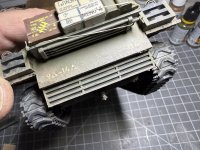
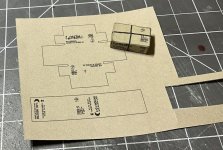
One of the other details I wanted to add to the stowage were the late war cardboard 10 in 1 C ration boxes. Because they had never been offered in 1/30th scale, Ericka and I sat down and looked at the few surviving examples and designed the box and the sleeve. These were made in lighter colored chipboard and later in the war from corrugated cardboard. Ericka is very talented in this type of scaling and layout work and the end results show it. Now that we have the artwork we can scale it up or down for future projects too. The boxes were assembled over basswood blanks with carpenter’s glue, the metal straps were added with lead foil and the boxes were lightly weathered. Other resin castings were selected and painted to embellish the model including ammunition cans, crates, gas and lubrication cans. Just about finished with this one…
 

Attachments

  • IMG_0939.jpeg
    IMG_0939.jpeg
    207.6 KB · Views: 6
  • IMG_6678.jpeg
    IMG_6678.jpeg
    213.8 KB · Views: 6
  • IMG_6675.jpeg
    IMG_6675.jpeg
    194.2 KB · Views: 6
  • IMG_0916.jpeg
    IMG_0916.jpeg
    236 KB · Views: 6
  • IMG_0914.jpeg
    IMG_0914.jpeg
    216 KB · Views: 6
  • IMG_0945.jpeg
    IMG_0945.jpeg
    166 KB · Views: 6
Outstanding Ken. I thoroughly have enjoyed reading and viewing your progress on this incredible build.
Mike
 
Thanks Mike, I am glad you are following the build. Ericka and I just returned from the U.S. Army National Museum and the National Museum of the Marine Corps where I was able to photograph details on the two Sherman tanks displayed at these great sites. The way they are displayed offered views of some details that are otherwise hard to see so I believe the next few tanks I build and detail may be even better!
 

Users who are viewing this thread

Back
Top